
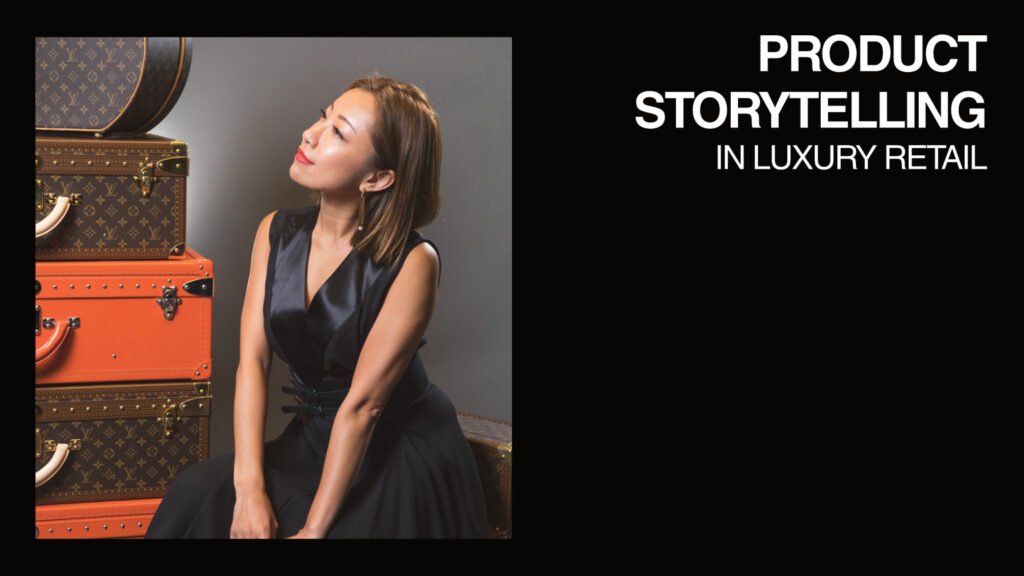
Product storytelling in luxury retail is the practice of turning what an advisor knows about a piece into a conversation that means something to one particular client. It connects craftsmanship, heritage and brand values to the client’s own motives for being in the boutique. Done well it is indistinguishable from ordinary conversation, which is why it is harder to teach than product knowledge.
What is product storytelling in luxury retail?
It is the discipline of translating product knowledge into emotionally relevant conversation. A specification tells a client what a piece is made of. A story tells her why it was made that way and what owning it would say about her, which is the question she is actually weighing.
Clients can read specifications online before they arrive. What they cannot get elsewhere is a person who interprets those facts in terms of their own life, which is the remaining advantage a boutique holds over a screen.
Why do most brand stories fail to land?
Because they are delivered rather than adapted. Organisations invest heavily in product knowledge and advisors become genuinely expert in materials and production, then use that expertise the same way with everyone who walks in. Three habits account for most of the damage.
The same story for every client
A narrative about a maison’s early archive can captivate a collector and lose a client buying her first serious piece. Effective storytellers adjust both the depth and the register of what they tell.
Explaining before discovering
Some advisors begin describing craftsmanship before establishing why the client came in. The strongest narratives are assembled after listening, from material the client has supplied.
Heritage without relevance
Luxury houses hold remarkable histories, and history only earns its place in a conversation when it explains why the piece in front of the client matters today. Otherwise it becomes a lecture the client is too polite to interrupt.
Where a good story begins
A good story begins with observation, well before the advisor starts speaking. Previous purchases, an upcoming celebration, a recent move, the way a client handles a piece and how much she volunteers about herself all indicate which story will land. These signals are available in the first few minutes of any appointment to an advisor who is looking for them.
This is where curiosity does its work in the Academy’s methodology, feeding the three Cs of Connect, Communicate and Cultivate. Storytelling belongs to Communicate, and it only functions if Connect has already been established.
Adapting the story to the client
An advisor adapts the story by reading how the client wants to be engaged, using a framework the whole team shares. This is what the Clienteling Wardrobe™ is for. It gives an advisor a way to read what a client wants from an interaction, and a way to see their own habits clearly enough to change them. Some registers come naturally to a storyteller, others have to be learned, in the way a person grows into a piece of clothing.
It has its roots in transactional analysis (Berne, 1964), moved out of the consulting room and onto the floor. In storytelling it decides length, whether to lead with the technical or the personal, and how much of the advisor’s own enthusiasm the client will welcome.
The storytelling methodology in practice
The methodology runs in a deliberate order, with room left for the conversation to move. The Academy teaches it as part of The Art & Science of Clienteling™ and applies it across fashion, jewellery, watches, hospitality and wine and spirits.
Discover the client’s story first
Every memorable narrative starts with the client. Advisors often feel pressure to demonstrate expertise early, and the ones who resist it learn what the purchase is meant to mark. A client celebrating a promotion, a client building a collection and a client choosing an anniversary gift need three different conversations about the same object.
Connect craftsmanship to personal meaning
Listing production techniques rarely moves anyone. Explaining why the technique exists usually does. Compare “this bag is hand stitched using traditional methods” with “each stitch is done by hand because it gives a precision a machine cannot reach, which is why clients who care about how things are made tend to choose this piece”. The second links the craft to something the client already believes about herself.
Make heritage relevant
Select the parts of the house’s history that support this client’s interest and leave the rest. A collector interested in design evolution wants a different century from a client buying her first watch, who is more likely to respond to the idea of something that will outlast her ownership of it.
How do you sell emotionally without theatre?
By helping the client articulate why the piece matters to her, rather than performing enthusiasm at her. Scarcity language such as “only a limited number are available this season” communicates value and applies pressure at the same time. Framing the same piece around what it commemorates lets the client arrive at the decision herself.
The practical test is whether the client does most of the imagining. When she starts describing where she will wear it or who she will show it to, the story has done its work and the advisor should stop adding to it.
Storytelling as a capability rather than a script
The variable in every appointment is the client, and no script survives contact with an unexpected answer. Brand manuals, product books and approved narratives are useful raw material, and none of them change behaviour on their own. Advisors need repeated practice, feedback and the chance to fail in a low stakes setting.
The Clienteling Academy develops it through the Clienteling Excellence Certification Ladder, which builds capability progressively across advisors and leaders, and the Clienteling Excellence Diagnostic Suite, which establishes where a business actually stands before any programme is designed. The Clienteling Embodiment Programmes then use Learning Labs to rehearse storytelling until it holds in real appointments, and graduates join the Clienteling Excellence Ambassador community.
The approach reflects our founder’s two decades of client development across Louis Vuitton, Burberry, Farfetch and DFS, where storytelling was treated as everyday practice rather than as an occasional source of inspiration.
Does your organisation need storytelling training?
A short honest audit will usually answer it. Boutique leaders should look at whether advisors adapt their stories to different clients, whether conversations start from discovery, whether the standard holds across boutiques while still sounding like the individual telling it, and whether managers coach storytelling with the same attention they give to sales performance.
• Advisors can explain why a product matters to this client, not only what makes it exceptional
• Stories vary by client rather than by season
• Discovery precedes presentation in most appointments
• Managers observe and coach the behaviour, not only the result
Book a Discovery Call or Request a Capability Assessment
Key takeaways
• A heritage story that fascinates a collector can bore a first time buyer into silence, and the difference is not the story.
• Storytelling begins with observation, well before the advisor says anything about the product.
• Craftsmanship detail only lands when it is tied to something the client already values in her own life.
• The strongest storytellers know when to stop talking, which is a skill that product books cannot teach.
• Treating storytelling as a script produces confident advisors who sound identical, which is its own kind of failure.
Frequently asked questions
How do you know whether storytelling is working?
The observable signals are repeat appointments with the same advisor and clients repeating the story back when they return. Neither appears in a monthly sales report, which is why managers have to be on the floor to see it.
Why does storytelling matter for luxury brands?
Luxury purchases are usually tied to identity and to moments worth marking, and a well judged story helps the client see the piece in that context.
Where should a storytelling conversation begin?
With the client. Discovery comes first, and the story is then selected from what the advisor has learned rather than delivered from memory.
How do advisors adapt their storytelling to different clients?
Through the Clienteling Wardrobe™, the Academy’s instrument for reading how a client wants to be recognised and how an advisor naturally shows up, drawing on transactional analysis (Berne, 1964).
Who benefits from luxury storytelling training?
Client advisors, boutique managers, retail and hospitality leaders and brand directors who want more consistent client conversations across their teams.