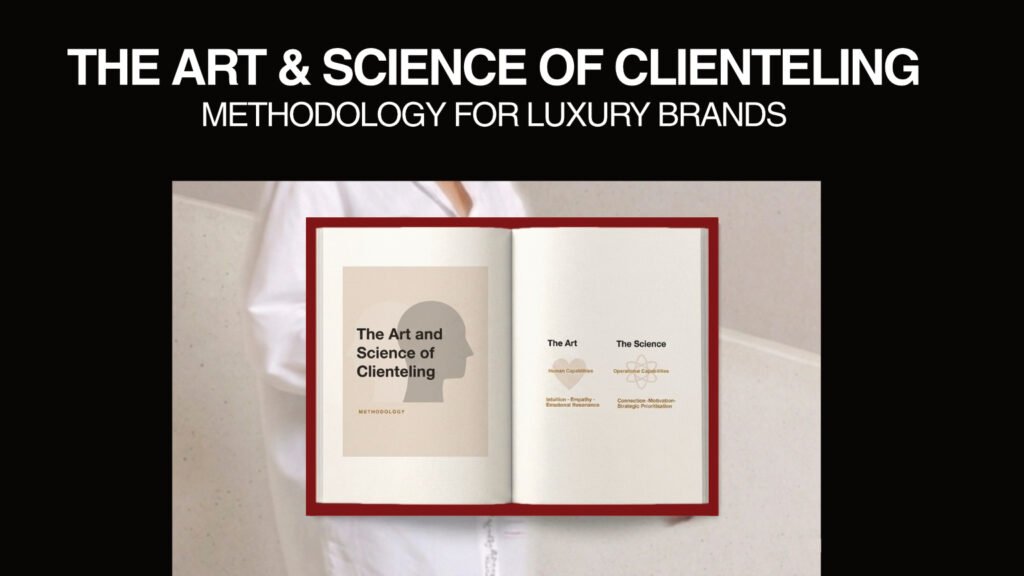
A clienteling methodology is a structured system for building and sustaining high value client relationships through repeatable behaviours rather than individual flair. The Art & Science of Clienteling™ is The Clienteling Academy’s version of that system, built for boutique floors where the relationship carries the commercial weight. It defines what an advisor does inside a client conversation and how a leader can tell whether it is actually happening.
What is a clienteling methodology?
A clienteling methodology is a defined set of behaviours, planning routines and conversation standards that allow a team to develop client relationships consistently, whoever happens to be on the floor that day. It differs from sales training in what it sets out to change. Sales training installs techniques for a single interaction, while a methodology governs a relationship that may run for years.
Two elements make one work. The first is a shared language for client behaviour, so that two advisors describing the same client describe her the same way. The second is commercial discipline, so that the language turns into appointments, follow up and revenue a leadership team can see in the numbers.
Why does luxury clienteling need both art and science?
Because instinct does not scale. Clients stay loyal to individuals who understand their preferences and anticipate what they will want next, and in most organisations that capability sits inside a handful of high performers who have never had to explain it. When it stays tacit, new advisors cannot acquire it and boutique managers cannot coach it.
The science exists to make the art transferable. It puts observable behaviours around something previously filed under personality, which gives a manager something to work on during a Tuesday morning briefing instead of a sales figure to react to at month end.
The art
The art covers the human capability that resists automation: reading unspoken need, giving a piece meaning for one particular client, presence in a room, and the patience to develop a relationship across several years without pushing. The Academy develops behavioural confidence here rather than scripted conversations, because a script fails the moment a client says something the script did not anticipate.
The science
The science covers client development planning, relationship prioritisation, behavioural measurement and the commercial rhythm of a portfolio. Advisors learn to identify where each relationship currently sits, what would move it forward and which clients merit the next hour of their attention. The Relationship Intimacy Circle and the SPCV model give that judgement a structure instead of leaving it to memory and mood.
Learning to read a client
Advisors learn to read a client through one shared framework taught across every programme. This is what the Clienteling Wardrobe™ is for. It gives an advisor a way to read what a client wants from an interaction, and a way to see their own habits clearly enough to change them. Some registers come naturally, others have to be learned, in the way a person grows into a piece of clothing.
The approach draws on transactional analysis (Berne, 1964), applied to the boutique floor rather than the consulting room. In practice it stops an advisor treating every client as a version of themselves. A collector who wants the technical history of a movement and a client who wants to be told the piece suits her are asking for two different conversations about the same watch.
What are the three Cs of clienteling?
Connect, Communicate and Cultivate. Connect covers the opening of a relationship and the conditions that make a client willing to share anything real. Communicate covers adapting the conversation to the person in front of you rather than repeating a house style at volume. Cultivate covers the months afterwards, which is where most relationships are either compounded or lost through neglect.
Building capability across an organisation
Capability spreads through connected structures rather than a workshop. A single training event produces enthusiasm that decays before the behaviour has changed. The Academy’s ecosystem is designed so capability is diagnosed first, developed in sequence, then rehearsed until it survives contact with a real client.
Clienteling Excellence Diagnostic Suite
Capability work starts with evidence about the current position. The Diagnostic Suite combines individual assessment, behavioural benchmarking and organisational audit, so a programme addresses what a business actually lacks. Leadership teams usually find the gap is narrower and more specific than they had assumed.
Clienteling Excellence Certification Ladder
The Certification Ladder gives client advisors, boutique managers and leadership teams a progressive route rather than one shared course. Each level assumes the behaviours below it are already in daily use. Progression is judged on demonstrated behaviour, which makes it slower and considerably more useful than attendance.
Clienteling Embodiment Programmes
Knowledge changes behaviour only when it has been rehearsed under mild discomfort. The Embodiment Programmes use Learning Labs where advisors practise storytelling, client development planning and awkward conversations repeatedly, with feedback, until the behaviour holds when a client is unpredictable. Graduates join the Clienteling Excellence Ambassador community, which keeps the practice alive between programmes.
What does the methodology look like on the boutique floor?
The methodology changes what an advisor does at the start of the conversation. Consider a returning client who comes in for a gift. A transactional approach establishes the recipient, the budget and the category, then presents options against those constraints.
A clienteling approach establishes the occasion, what the client hopes the recipient will feel on opening it, and what she has bought from you before. The advisor may well sell the same piece at the same price. The difference appears later, in whether that client asks for the advisor by name.
Does the methodology work outside luxury fashion?
Yes, and it has been applied across watches, jewellery, hospitality, wine and spirits and premium retail concepts. Products, price architecture and heritage differ sharply between those sectors. The behaviours that build a long
relationship with a discerning client are largely constant, so the methodology transfers with adjustments to language and context rather than to structure.
Who is the methodology for?
Client advisors, boutique managers, retail leadership and client experience teams who carry responsibility for relationship led growth. It draws on our founder’s two decades of client development across Louis Vuitton, Burberry, Farfetch and DFS, so the examples come from boutique floors and regional leadership meetings rather than from a textbook. Organisations engage the Academy in several formats.
• Keynotes and conference sessions for regional leadership
• Learning Labs for advisor and manager cohorts
• Clienteling Behaviour Excellence Audits
• Multi market capability programmes built on the Certification Ladder
Book a Discovery Call or Request a Capability Assessment
Key takeaways
• A clienteling methodology earns its place by making the behaviour of your strongest advisor learnable by your newest one.
• Instinct alone produces excellent individuals and inconsistent boutiques, which is the reason the science half of the methodology exists.
• The Clienteling Wardrobe™ reads in both directions, so an advisor confronts their own default style before attempting to read a client’s.
• Connect, Communicate and Cultivate is the sequence, and Cultivate is where most luxury relationships quietly fail.
• Diagnosis comes before design: the Diagnostic Suite exists so a capability programme addresses the gap a business actually has rather than the one it assumed.
Frequently asked questions
How long does it take to embed the methodology?
Advisors change observable behaviour where managers coach it consistently. Embedding it as the way the business works is a sustained piece of leadership rather than a programme.
How is The Art & Science of Clienteling™ different from sales training?
Sales training improves a single interaction, usually through technique. This methodology develops the behaviours, planning and leadership routines that sustain a client relationship over years.
What is the Clienteling Wardrobe™?
It is the Academy’s instrument for reading how a client wants to be recognised and how an advisor naturally shows up, drawing on transactional analysis (Berne, 1964). It reads in both directions, so advisors learn their own default alongside the client’s.
What usually goes wrong when a brand adopts a methodology?
It is launched as an initiative owned by learning and development, and boutique managers are informed about it rather than held accountable for it. The behaviour then lasts about as long as the enthusiasm does.
Can the methodology be used outside luxury retail?
Yes. It is in use across hospitality, wine and spirits and other relationship led sectors, with the language adapted to the category while the underlying behaviours stay the same.