
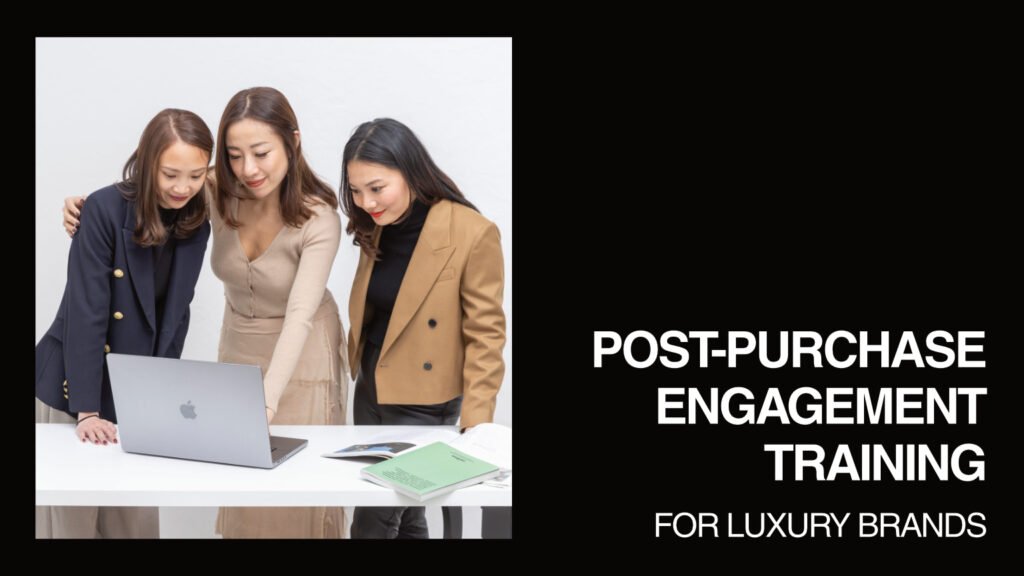
Post-purchase engagement is the practice of continuing a client relationship after the sale through contact that has a reason to exist. In luxury it is the point at which a strong boutique experience either compounds into loyalty or fades into a receipt. Training it means teaching advisors when to make contact, what to say and how to judge the moment.
What is luxury post-purchase engagement training?
Luxury post-purchase engagement training is a structured capability programme that teaches client advisors how to sustain meaningful contact after a purchase so that each interaction strengthens trust and creates a credible reason for the next conversation. It works on behaviour rather than templates. Advisors learn to judge timing, personalise a message from what they genuinely observed, and recognise a commercial opportunity without crowding the client.
The Clienteling Academy teaches it as part of The Art & Science of Clienteling™, which pairs the human side of the relationship with the planning discipline that keeps it alive over time. The working principle is straightforward. A completed sale is the opening of a relationship rather than the end of one.
Why does the period after the sale matter commercially?
Because acquisition is expensive and existing clients are the most under used asset most luxury businesses hold. The Bain and Altagamma Luxury Goods Worldwide Market Study has tracked the rising importance of existing client value as acquisition costs climb, and the pattern is consistent across categories. A brand that invests heavily in attracting a client and then goes quiet has paid full price for a single transaction.
Sustained engagement also improves the quality of what a boutique knows. Every well judged follow up returns information about how the client wears the piece, what is coming up in their year and how they prefer to be contacted, which makes the next conversation better informed than the last.
What should happen in the first forty eight hours?
A short, specific message should reach the client, thanking them and adding something they did not have when they left. This window is when the purchase still feels significant and the boutique conversation is still fresh in memory. Advisors tend to fail it in two directions, either following up immediately with another product suggestion or waiting until the moment has gone.
What a strong first message contains
• Genuine thanks, addressed to the client rather than to the transaction
• A reference back to something specific she said in the boutique
• One piece of practical value, such as care or styling guidance
• An open door for questions, with no request attached
Why generic thank yous fail
A message such as “Thank you for your purchase, we hope to see you again soon” could have been sent to any client in the database, and clients read it exactly that way. Personalisation requires observation during the appointment itself. An advisor who noted the wedding the piece was bought for, or the trip it will travel on, has something to write about; an advisor who noted only the SKU does not.
Where repeat purchases come from
Repeat purchases come from anticipating what will matter to the client next, months before there is anything to sell. High performing advisors keep a running answer to that question for every client in their portfolio, and it reshapes the calendar of contact. Promotional frequency has very little to do with it.
Timing against the client’s year
Clients preparing for travel, a wedding or a significant professional moment welcome curated suggestions when those moments are approaching. The same suggestion sent at the wrong point in the year reads as inventory pressure.
Ownership and care
Luxury ownership continues long after the purchase. Care guidance, servicing reminders and craftsmanship detail reinforce the value of what the client already owns and give an advisor a legitimate reason to be in touch that asks for nothing.
Recognition of milestones
Birthdays, anniversaries and family events create honest openings to reconnect. They only work when the record behind them is accurate, which is a discipline question for the boutique rather than a system question.
Matching tone to the client
Advisors learn to read tone, using one shared framework across the team. The Clienteling Wardrobe™ is the Academy’s instrument for this. Applied to a client it describes how they want to be met; applied to the advisor it describes the style they fall back on under pressure. Most advisors have two or three registers they wear comfortably and the rest take deliberate practice, message by message.
It has its roots in transactional analysis (Berne, 1964), moved out of the consulting room and onto the floor. In follow up it decides very practical things: message length, how much warmth to open with, whether to lead with the detail of the craft or with the occasion the piece was bought for.
How do you reactivate a lapsed client without damaging trust?
Start with curiosity about why they stopped, then find a reason to make contact that has nothing to do with a sale. The instinctive response in most organisations is a discount or a collection announcement, which tells the client the relationship reawakens when revenue is needed. That is what the scoreboard asked for, and clients can see it.
Before reaching out, an advisor should be able to say what originally motivated the client to buy, what may have changed in her life since, and what the brand can offer her before anything is proposed. A private preview invitation or a note recognising a milestone will usually restart a relationship that a promotion would have closed for good.
Does CRM solve post-purchase engagement?
No. CRM platforms schedule reminders, hold preferences and route tasks reliably, and none of that generates trust. Many luxury organisations have bought sophisticated systems and left the behavioural capability to use them well undeveloped, which produces a well organised stream of forgettable messages.
When advisors understand curiosity, timing and adaptive communication, each CRM prompt becomes an opening rather than an administrative task to clear before close.
How is this capability built across a business?
Through diagnosis, structured progression and rehearsal. The Clienteling Excellence Diagnostic Suite establishes where individual and organisational capability currently sits, so a programme is designed against real gaps. The Clienteling Excellence Certification Ladder then develops advisors and managers progressively rather than through a single shared course.
The Clienteling Embodiment Programmes carry it into daily practice through Learning Labs, where advisors draft, send and critique real follow up until the judgement becomes instinctive. This approach draws on our founder’s two decades of client development across Louis Vuitton, Burberry, Farfetch and DFS.
Book a Discovery Call or Request a Capability Assessment
Key takeaways
• The forty eight hours after a luxury purchase are the cheapest relationship building opportunity a brand will get, and most boutiques spend them doing nothing.
• A thank you message that could have been sent to anyone tells the client exactly how closely they were being listened to.
• Repeat purchases come from anticipating what will matter to a client next, which is a planning habit rather than a personality trait.
• Reactivating a dormant client with a discount confirms their suspicion that the relationship was only ever about revenue.
• CRM schedules the reminder; the advisor decides whether the message that follows is worth receiving.
Frequently asked questions
How often should an advisor be in touch after a purchase?
Frequency is the wrong question. Make contact when there is a reason the client would recognise as relevant, rather than on a schedule.
Should follow up be written by the advisor or by the central team?
By the advisor, in their own words, from what they observed in the appointment. Central teams can supply the reason and the product detail, but a centrally drafted message reads as a campaign however it is signed.
How does post-purchase engagement increase repeat purchases?
Consistent contact that carries value rather than promotion keeps the advisor in the role of trusted counsel, so the next purchase feels like a continuation of an existing relationship.
How do advisors adapt their follow up to different clients?
Through the Clienteling Wardrobe™, the Academy’s instrument for reading how a client wants to be recognised and how an advisor naturally shows up. It informs tone, length and what to lead with.
Can a CRM system deliver this on its own?
No. A CRM schedules and records the contact, while the quality of what the client receives depends entirely on the advisor’s behaviour and judgement.