
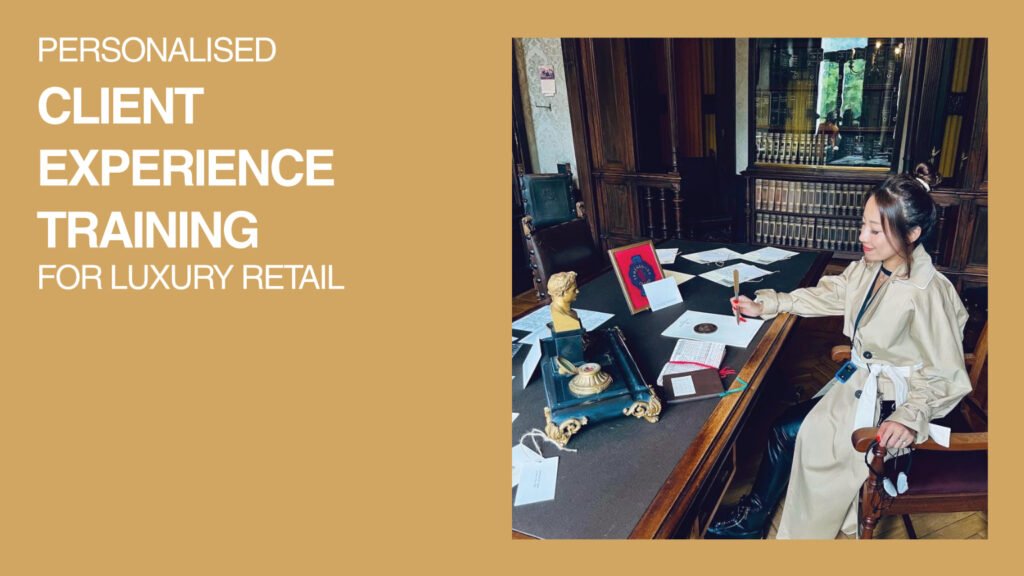
Personalised client experience training develops the behaviour that lets a client-facing team run an appointment built around the individual in front of them rather than a standard visit with a name attached. It is bought by retail directors, brand directors and learning leads who need that standard to hold across boutiques and markets rather than in the hands of a few strong advisors. The subject is behaviour, not software, and behaviour is the part that has to be rehearsed.
What does this training actually develop?
The training develops what an advisor does with what they already know. Recording a client’s birthday is administration. Being able to say inside an appointment why this particular client will respond to this particular piece, and being right often enough that the client comes to rely on it, is a skill that can be taught, coached and observed.
A programme covers preparation before an appointment, the questions that open one, curation of what is presented, reading and adjusting during the conversation, and the follow up that decides whether there is a next appointment at all. Product training addresses none of that, which is why brands with excellent product knowledge still find their client experience uneven from one boutique to the next.
Why is personalisation now a capability problem rather than a talent problem?
Clients arrive better informed and less patient than they were. Most have researched before entering, hold conversations with the brand across several channels, and expect an advisor to know what was discussed last time regardless of where it happened. The Bain and Altagamma Luxury Goods Worldwide Market Study has described aspirational buyers stepping back and the market leaning more heavily on a brand’s committed clients, which raises the cost of an appointment the client forgets.
A brand whose personalised service depends on a handful of exceptional advisors does not have a capability. It has a staffing risk. Most organisations discover this the year a top performer transfers and a market’s numbers follow her out of the door.
The behaviours a programme has to change
Preparation that goes beyond the file
Advisors who prepare well arrive with a point of view: what the client is building towards, which occasion is coming, what she was offered last time and declined, what she mentioned twice. Advisors who prepare badly read the file on the way to the door and arrive with a summary rather than a plan, which the client can hear within the first exchange.
Curating rather than presenting
A narrow, well reasoned selection reads as competence. A rail of everything available reads as an advisor who has not thought about it. Editing takes nerve, since a short selection cannot hide behind volume if it misses, and building that nerve is a training problem rather than a personality trait.
Follow up that is not a template
Most follow up fails for the same reason: it is written to a schedule rather than to a person. A message that refers to something said in the appointment, sent when it is useful to the client rather than when the system prompts it, is the least expensive differentiator available to a boutique and the one most often left unused.
How do advisors adapt to a client they have not met before?
Advisors need a shared way of reading people, taught across the team so it survives a handover. The Academy calls this the Clienteling Wardrobe™. It reads the client and the advisor with the same instrument, which is what makes it coachable: a manager can name the register an advisor defaults to and the one they avoid. Some are instinctive, others are learned the way a new style is learned.
The approach draws on transactional analysis (Berne, 1964), applied to the boutique floor rather than the consulting room. Its value is in the ordinary decisions inside an appointment: how quickly to move, how much detail to offer, whether to open with the craft behind a piece or with the occasion the client has in mind.
The same discipline, different appointments
Consider a long standing client booking ahead of an international trip. The advisor reviews her history, checks where she is going and what she will be doing there, and prepares a focused selection rather than a rail. The conversation covers the trip, the wardrobe she is building and what she will need by next season.
Consider a first time buyer visibly uncomfortable with the amount of money involved. The advisor slows the pace, finds out what the piece is meant to mark, and answers the anxiety before addressing the product. Both appointments run on the same discipline and look almost nothing alike from the outside, which is the point a scripted programme cannot reach.
How should a brand assess its current position?
Behaviour is the thing to examine, not sales outcomes. Conversion and average transaction value describe what happened at the end of an appointment and say very little about what produced it. The questions below tend to expose the real position quickly, and they are worth asking of boutique managers and advisors separately.
• Can advisors explain why a specific client will respond to a specific piece, or only what that client bought last?
• Are appointments genuinely prepared, or standardised with a personal greeting attached?
• Can advisors adapt across personalities and cultures, or does everyone fall back on one house style?
• Is the standard consistent across boutiques, or carried by a few individuals?
• Are boutique managers coaching these behaviours, or only reviewing the numbers they produce?
How does the Academy deliver this across an organisation?
The Clienteling Excellence Diagnostic Suite establishes current capability at individual and organisational level, so investment is aimed at real gaps rather than assumed ones. The Clienteling Excellence Certification Ladder then develops advisors, personal shoppers, boutique managers and leaders along a progressive route, with managers taught the same language as their teams so they can coach it afterwards.
The Clienteling Embodiment Programmes carry the learning into daily practice through Learning Labs, where behaviours are rehearsed with feedback until they hold under real conditions. The work draws on our founder’s two decades of client development across Louis Vuitton, Burberry, Farfetch and DFS, and sits inside The Art & Science of Clienteling™, which pairs the human craft of relationship building with the client development discipline that keeps it commercially useful.
Book a Discovery Call or Request a Capability Assessment
Key takeaways
• Personalised service that lives with a handful of exceptional advisors is a staffing risk rather than a capability, and it moves a market’s numbers when those advisors transfer.
• Product training does not produce personalised appointments, which is why brands with excellent product knowledge still see uneven client experience across a network.
• Curation is the behaviour clients read as competence: a narrow selection an advisor can justify beats a rail they cannot.
• Boutique managers decide whether a programme survives, because behaviour that is not coached reverts to whatever the scorecard rewards.
• The Clienteling Wardrobe™ makes reading a client coachable, since a manager can name the register an advisor defaults to and the one they avoid.
Frequently asked questions
How long does it take before this shows in a boutique?
Individual advisors change quickly once a manager coaches them consistently. A whole network takes considerably longer, because the constraint is manager attention rather than advisor willingness.
Does this work in markets where direct personal questions are considered intrusive?
The behaviours transfer, the delivery does not. A programme that works internationally teaches advisors to read the room and adjust register rather than to run one culturally specific script, which is part of why the Wardrobe reads the advisor as well as the client.
Should personal shoppers and boutique managers train separately from advisors?
Teach them the same material and separate them for practice. Managers need their team’s language to coach it, but their rehearsal is coaching conversations rather than client conversations.
What usually goes wrong when brands try to personalise at scale?
Treating it as a data exercise, so the client system fills with detail nobody uses in an appointment. The second common failure is leaving boutique managers out, which lets the behaviour fade as soon as the training event ends.
How do we know the training worked?
Observe appointments before and after against agreed behaviours, and have managers record what they see rather than relying on a post-course survey. Sales figures move for many reasons; observed behaviour moves for one.