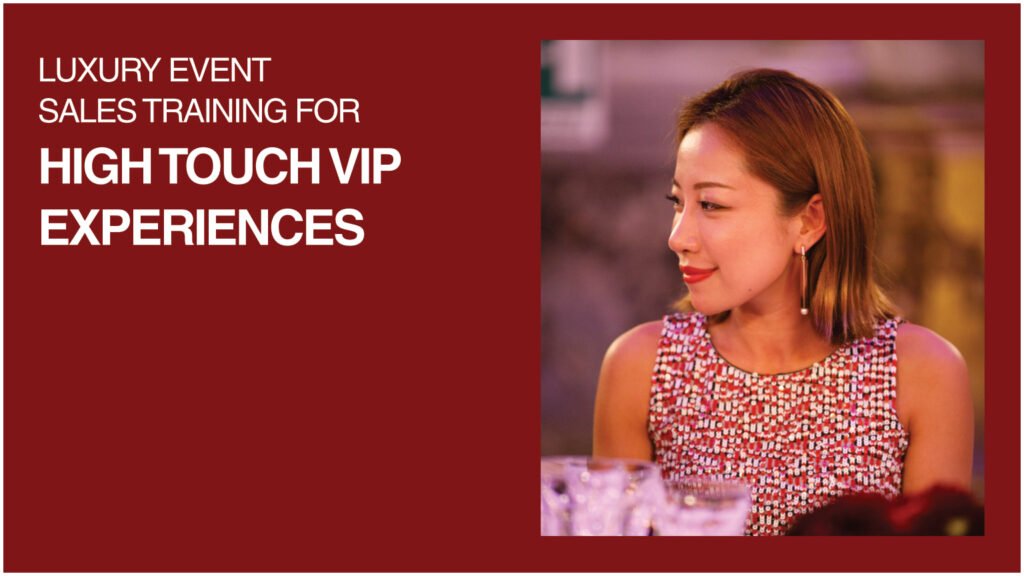
Luxury event sales training develops the behaviours, commercial judgement and communication capability that turn a private event into a client relationship. It focuses on the people holding the conversations rather than on the logistics around them. The measure of success is what happens in the weeks after the guests leave.
What is luxury event sales training?
Luxury event sales training is a capability programme that prepares client advisors, boutique leaders and event teams to create commercially productive experiences through personalised engagement and relationship led selling. It differs from event management training in what it develops, since event management perfects the execution while this work develops the human interactions taking place inside it.
The practical objective is that every guest leaves having had a conversation that could only have happened with them, and that the advisor leaves with something specific enough to act on. Flawless delivery without either of those produces a pleasant evening and no measurable outcome.
Why have private events become strategic clienteling moments?
Because a private event gives an advisor a kind of context that no boutique visit provides. Exclusive previews, intimate dinners, craftsmanship demonstrations and private appointments let advisors observe how a client behaves socially, who they bring, what draws their attention and what they volunteer when nobody is selling anything. That intelligence is the raw material of client development.
The wider shift is well documented in industry research. The Bain and Altagamma Luxury Goods Worldwide Market Study tracks the continued growth of experiential luxury, and the McKinsey and Business of Fashion State of Fashion report examines the role of personalised experience in luxury competitiveness. Readers should consult those reports directly rather than secondary summaries of them.
What has to happen before the event?
The work that determines commercial outcome takes place weeks in advance, in three areas that are frequently rushed.
Guest selection
A guest list assembled from last year’s top spenders will fill a room and rarely develops anything. Selection should account for purchase history, personal interests, life stage, relationship potential and which advisor already holds the relationship. Where an advisor cannot explain why a particular client was invited to this particular event, the invitation is a mailing.
Personalised invitations
An invitation is the first test of whether the event was designed with the client in mind. Referencing something specific, a previous purchase, an interest, a conversation from an earlier visit, changes an invitation from an announcement into an approach. The Art of Clienteling treats this as part of understanding what a client has not said aloud.
Appointment planning
Most events benefit from structured appointments running alongside the informal programme. Preparation lets advisors curate a relevant selection, anticipate hesitation, brief colleagues who will be in the room and plan the transition into a boutique follow up. Preparation also removes pressure from the conversation itself, which is what allows an advisor to be genuinely present.
What separates a real event conversation from a scripted one?
The advisor’s ability to read the guest in front of them and adjust in real time. One guest wants the story of the atelier and will stay as long as it takes to hear it, another is scanning the room for the exit and wants a precise recommendation delivered without ceremony. Serving the second like the first is how a brand loses a client without ever hearing a complaint. The Academy teaches this as the Clienteling Wardrobe™, an instrument for reading how a client wants to be recognised and how an advisor naturally shows up. It works in both directions, so an advisor learns their own default before trying to read anyone else’s. Like a wardrobe, some pieces are instinctive and others take practice to wear well in a room of guests.
At an event the Wardrobe is used quickly and quietly, because an advisor has minutes rather than appointments to calibrate. The same instrument then supports the debrief the following morning, where a manager can ask which register the advisor reached for and whether it was the one the guest was asking for. Used that way it is a debrief tool rather than a classroom model.
The other differentiator is the specific gesture. Remembering a preferred drink, introducing a designer personally, acknowledging a family milestone or preparing an item connected to a previous purchase all register as recognition, and they are remembered long after the product presentation has faded.
Where the value appears after the event
The event creates information and the follow up is what converts it. A generic thank you email discards everything learned in the room. A follow up that references the conversation, the piece the client kept returning to and the trip they mentioned, sent while the evening is still fresh, continues a relationship rather than closing a file.
Each guest interaction should generate something actionable for the client record.
• Upcoming celebrations, milestones or gifting occasions.
• Travel plans that indicate which market will see the client next.
• Collecting interests and categories the client has not yet bought into.
• Changes in circumstance that will shape what the client needs next.
Judged properly, an event is measured on repeat appointments booked, follow up engagement, the quality of conversations recorded and the movement of individual relationships. Attendance and immediate sales on the night are the weakest available indicators, and they are usually the only two reported.
Where do luxury events most often go wrong?
They go wrong when the organisation invests in production and leaves the client conversation to chance. Three failures account for most of it: treating every guest identically, measuring attendance instead of relationship movement, and building the entire programme around the product when clients are buying identity and belonging. None of these are budget problems.
How does The Clienteling Academy build event capability?
Event capability is developed inside the Academy’s wider ecosystem rather than as a standalone workshop. The Clienteling Excellence Certification Ladder builds capability progressively, the Clienteling Excellence Diagnostic Suite identifies where the gaps sit before design begins, and the Clienteling Embodiment Programmes rehearse the behaviour through Learning Labs until it holds in a live room.
Participants develop sharper client perception through the SPCV model, greater confidence with VIP guests, structured client development habits and the leadership behaviours that shape how a boutique team prepares for an event. This draws on our founder’s two decades of client development across Louis Vuitton, Burberry, Farfetch and DFS, alongside the Clienteling Excellence Ambassador community that keeps the standard visible between programmes.
If your organisation wants to strengthen VIP experiences through behavioural capability, The Clienteling Academy offers bespoke programmes, event sales training, behavioural diagnostics and Learning Labs.
Book a Discovery Call or Request a Capability Assessment
Key takeaways
• Brands routinely spend more on the flowers than on preparing the people who will actually hold the conversations.
• An event guest list assembled from last year’s spend is a report, and a guest list assembled from relationship potential is a strategy.
• The commercial value of a private event is created in the follow up afterwards, which is also when most teams move on to the next one.
• Attendance is the easiest event metric to collect and the least informative one available.
• A guest who is treated exactly like every other guest has been given hospitality, which is not the same as recognition.
Frequently asked questions
How far ahead of an event should the team be prepared?
Weeks ahead, starting at the point the guest list is being built, because guest selection is where most of the commercial outcome is decided. A briefing on the day covers logistics and little else.
Who should attend?
Client advisors, boutique and retail managers, hospitality professionals, event directors and client experience leaders responsible for high net worth relationships.
How does it differ from event management training?
Event management develops logistics and execution, while event sales training develops the conversations, judgement and follow up discipline that create commercial value from those logistics.
How should a luxury event be measured?
Through repeat appointments booked, follow up engagement, the quality of client intelligence gathered and relationship progression, rather than through attendance figures alone.
Which frameworks does the Academy use?
The Art & Science of Clienteling™, the Three Cs of Connect, Communicate and Cultivate, the Clienteling Wardrobe™ and the SPCV model, delivered through the Certification Ladder, Diagnostic Suite and Embodiment Programmes.