
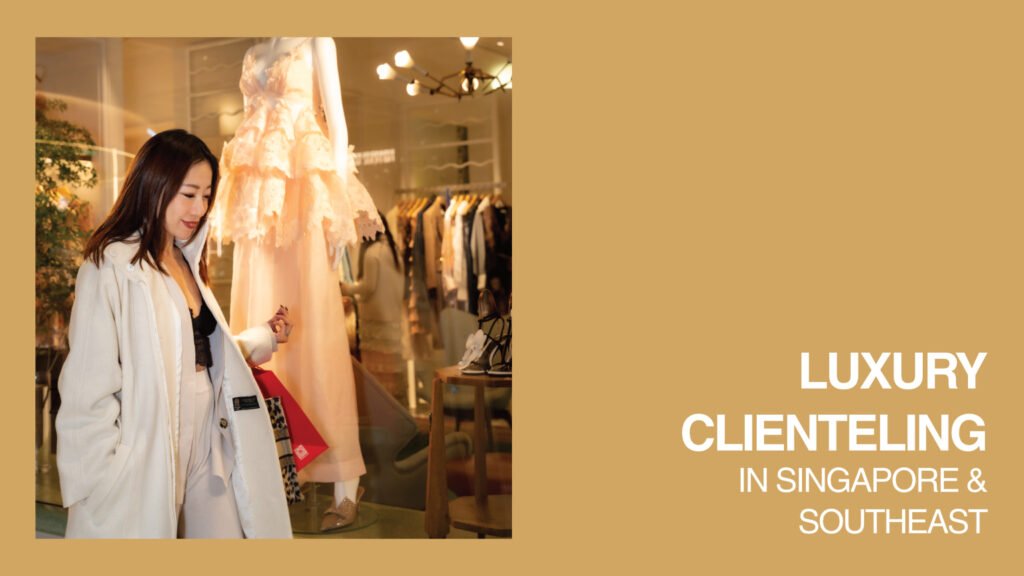
Luxury clienteling in Singapore is the practice of building long-term client relationships in a market where much of the clientele is in transit. A boutique on Orchard Road may host a Jakarta family, a Bangkok collector and a visiting executive within one afternoon, each with a different idea of what attention should feel like. The capability that matters is reading the individual quickly and being right often enough.
What is luxury clienteling in Singapore?
It is structured relationship building with local and visiting affluent clients, carried across borders and repeat trips rather than confined to a single visit. The practical test is whether the boutique can resume a conversation on the client’s next trip without the client having to re-explain themselves.
This matters more here than in a domestic market. Many purchases happen during a business trip or a regional shopping visit, so the advisor may get one appointment before the client is back on a plane. What the boutique does after the visit decides whether there is ever a second.
Why is Singapore different from other Southeast Asian markets?
Because it functions as a regional hub rather than a domestic market. Clients arrive having been hosted in Paris, Tokyo, Dubai and London, and they benchmark accordingly. The standard is set by the best experience they have had anywhere in the world.
That comparison is unforgiving in a very practical way. A client who is recognised instantly in one flagship and treated as a walk-in on Orchard Road draws a conclusion about the brand rather than about the boutique, and the conclusion travels.
The Bain and Altagamma Luxury Goods Worldwide Market Study has tracked how far purchasing behaviour now turns on experience and personal engagement rather than product access alone. For a Singapore boutique that shifts the burden of differentiation almost entirely onto the client relationship.
Adapting across a regional clientele
Adaptation starts with observing the person rather than applying a template to the passport. The useful signals are behavioural: pace, how much detail a client asks for, whether they decide alone or want a companion involved, and how comfortable they are with silence. These can be read quickly and are far more reliable than an assumption about market origin.
This is the reasoning behind teaching behavioural capability rather than market etiquette lists. Etiquette guidance dates quickly, does not survive contact with an individual who does not fit it, and tends to make advisors more cautious rather than more perceptive.
What makes an appointment worth having?
An appointment earns its place when it produces information that makes the next contact straightforward. A curated selection and a private room are the minimum entry standard. The distinguishing work is the conversation about upcoming occasions, family milestones and how the client actually wants to be contacted.
• A small, reasoned selection prepared in advance, with a stated reason for each piece.
• A conversation that establishes future occasions rather than only today’s need.
• An agreed follow-up with a date and a named owner before the client leaves.
• A client record a colleague in another market could act on without a phone call.
Consider two advisors hosting the same visiting client. The first presents a considered selection, completes the sale and closes the appointment. The second establishes that the client is travelling for a family celebration and that her son collects watches, then coordinates with a colleague in the market she flies to next. Both delivered a good appointment. Only the second produced something the brand can still act on long after the visit.
The case for investing in behavioural capability
Consistency across a region is a behavioural problem before it is a systems problem. CRM platforms record what a client bought. They do not record how that client prefers to be approached, and they cannot make an advisor comfortable enough to ask.
Product training also has a ceiling. Once every team in the market knows the collection equally well, the remaining variance in performance sits in how advisors handle uncertainty, silence and clients who are not ready to buy. That is where capability investment now returns the most, and it is the part that transfers when an advisor moves boutique.
Managers are the multiplier. Where boutique leaders coach behaviour as part of daily operations, new habits survive; where they audit activity instead, teams revert to the metric on the wall, because that is what the scoreboard asked for.
How does The Clienteling Academy build clienteling capability across Asia?
Through The Art & Science of Clienteling™, which combines the human craft of client relationships with the commercial discipline that keeps client development accountable. The SPCV model sharpens client perception so advisors collect information they can act on rather than impressions they cannot pass to anyone else.
The Academy calls this the Clienteling Wardrobe™. It reads the client and the advisor with the same instrument, which is what makes it coachable: a manager can name the register an advisor defaults to and the one they avoid. Some are instinctive, others are learned the way a new style is learned in an unfamiliar market.
For a regional team the value is that advisors across markets end up with the same language for describing a client, and the Clienteling Wardrobe™ is what supplies that language when a relationship is handed across a border.
The methodology comes from our founder’s two decades of client development across Louis Vuitton, Burberry, Farfetch and DFS. It is delivered through three connected pillars.
• The Clienteling Excellence Certification Ladder, a structured pathway across advisors, managers and senior leaders.
• The Clienteling Excellence Diagnostic Suite, which establishes current capability before any programme is designed.
• The Clienteling Embodiment Programmes, where Learning Labs turn storytelling, influence and client development into everyday practice.
Participants also join the Clienteling Excellence Ambassador community, which keeps practice moving between markets rather than staying inside one boutique.
Book a Discovery Call or Request a Capability Assessment
Key takeaways
• Most of Singapore’s luxury clientele is in transit, so an advisor may get one appointment before the client boards a plane, and what follows decides whether there is a second.
• Clients benchmark Orchard Road against the best hosting they have received anywhere, and someone recognised instantly in Ginza but treated as a walk-in here draws a conclusion about the brand.
• Nationality generalisations are convenient and unreliable; the signals worth reading are pace, appetite for detail and how comfortable a client is with silence.
• A CRM records what a client bought and cannot record how they prefer to be approached, which is why regional consistency is a behavioural problem before it is a systems problem.
• Once every team knows the collection equally well, the remaining variance in performance sits in how advisors handle uncertainty and clients who are not ready to buy.
Frequently asked questions
What are the best practices for clienteling in Singapore?
Treat every visit as the start of a relationship rather than a completed transaction, read behavioural signals rather than nationality, and agree a specific follow-up before the client leaves the boutique.
What happens when an advisor leaves and the client goes with them?
The relationship survives if the record is good enough for a colleague to continue the conversation, and it does not if the record only holds transactions. That is an argument for writing down what was observed, not only what was bought.
How should advisors handle a regionally diverse clientele?
By reading the individual in front of them. Pace, appetite for detail and comfort with silence tell an advisor more than any assumption based on where the client flew in from.
What is the SPCV model?
It is the framework the Academy uses to sharpen client perception, so that what an advisor notices during an appointment becomes information a colleague in another market can act on.
How do we keep a client relationship alive across markets?
Record what a colleague would need in order to continue the conversation, agree who owns the next contact, and make sure that contact carries a reason relevant to that specific client.