
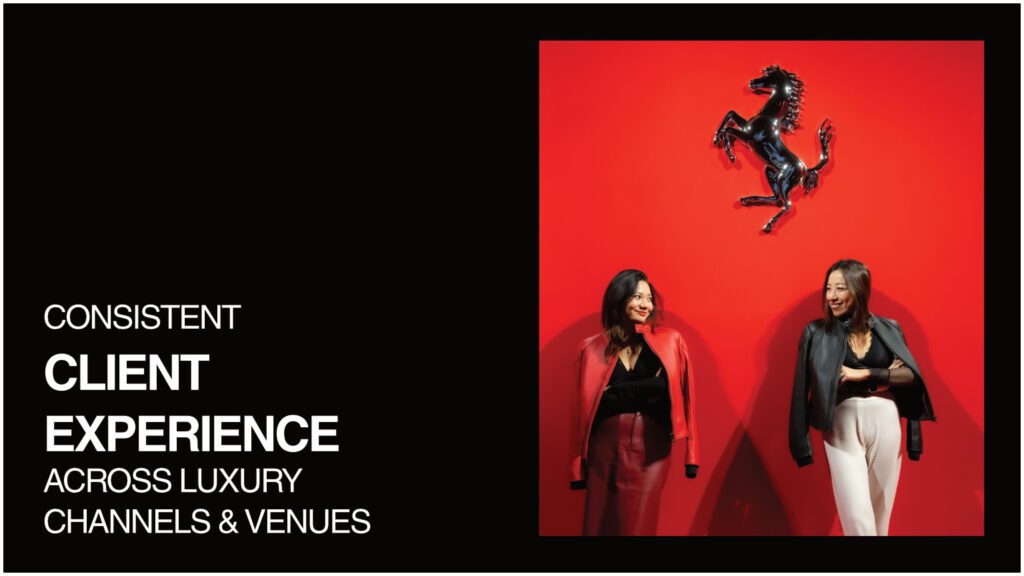
Consistency of client experience means a client is recognised and held to the same standard whichever part of a brand they walk into, whether that is a boutique, a members’ club, a restaurant, an event or a message thread with an advisor. It is a behavioural question before it is a systems question, because the information usually exists somewhere in the business and the difficulty is what a person does with it at the point of contact.
What does consistency of client experience actually mean?
Consistency is not uniformity of script. A client does not expect the concierge at a hospitality venue to speak like a watch specialist. They expect both to know who they are, to hold the same standard of attention, and to pick up a conversation rather than start one from nothing.
The test is easy to state and hard to pass. A client who spent an afternoon with an advisor discussing a commission should not have to explain that commission again to the person greeting him at the private dinner he is invited to afterwards. When that happens the client draws the obvious conclusion, which is that the brand’s parts do not speak to each other.
Where does the experience break between channels and venues?
The handover breaks. Departments built at different times keep separate targets, separate systems and separate definitions of a good week, and nothing in that arrangement rewards a boutique for telling the members’ club what it learned. The people involved are not uncooperative; they are measured on something else.
The cost of that failure lands on the client as effort. Harvard Business Review made the case in Stop Trying to Delight Your Customers that reducing the effort a customer has to spend does more for loyalty than occasional moments of delight, and repeating yourself to a brand that visibly already holds the information is effort of the most irritating kind.
Most organisations that reach this point have already bought the technology. A client record captures the relationship but does not conduct it, and a field nobody reads before an appointment is indistinguishable from a field that was never filled in.
What consistency requires of a team
Curiosity that reaches past the transaction
Advisors who ask about the wider life of a client rather than about today’s purchase create the openings that let another part of the brand be introduced without it sounding like a cross sell. A client who has mentioned that he sails is straightforward to invite to something on the water. A client who has only ever been asked about his size is not.
Notes written for the next person
Client records are usually written as an aide memoire for the advisor who made them, which is exactly why they are useless to anyone else. Writing for a colleague who has never met the client changes what goes in: what the client is building towards, how he prefers to be contacted, what he has already been offered and declined, and what he cared about enough to mention twice.
How do colleagues in different venues read the same client?
Clients want different things from the same interaction. Some want depth and expertise, some want reassurance, some want speed and discretion above all, and the same client can want different things on different days. This is what the Clienteling Wardrobe™ is for. It gives an advisor a way to read what a client wants from an interaction, and a way to see their own habits clearly enough to change them. Some registers come naturally, others have to be learned, in the way a person grows into a piece of clothing.
The underlying idea comes from transactional analysis (Berne, 1964). Across venues its practical value is blunt: two colleagues who will never both meet the same client can still describe him in terms the other recognises, which is what a written handover has to achieve if it is going to change how the next interaction runs.
Why does a community hold a brand to a higher standard than a loyalty programme?
A loyalty programme rewards spending. A community rewards belonging, and the members of one talk to each other, compare what they were offered and notice inconsistency faster than any internal report will surface it. Recognition that varies by venue becomes a subject of conversation rather than a private irritation.
Benefits still matter. What sustains a community is emotional investment: shared experiences such as private previews and cultural programming, recognition for who someone is rather than what they bought, conversation that continues between purchases, and the same understanding of the client whichever advisor or venue they meet next.
One relationship, several teams
Take a brand running boutiques, a members’ club, a hospitality venue and a private events programme. Without behavioural alignment each of those is a separate good experience, and the client does the work of joining them up. Most clients will not bother; they simply use the part of the brand that knows them and ignore the rest.
Aligned, a boutique conversation shapes the invitation the events team sends, an exchange at that event produces a product recommendation nobody had to invent, and a concierge interaction improves the next appointment on the shop floor. The client experiences a single relationship. Internally it was handled by people who never met, none of whom was told what to say.
How does The Clienteling Academy build this?
The Clienteling Academy works from the Diagnostic Suite, which establishes where capability sits before anything is designed, the Certification Ladder, which develops advisors and leaders progressively, and the Embodiment Programmes and Learning Labs, where behaviour is rehearsed with feedback until it holds under pressure.
Across venues the sequencing matters as much as the content. Programmes that begin with the boutique and add the other venues later tend to reproduce the hierarchy the client is already complaining about. Programmes that put a concierge, an advisor and an events manager in the same Learning Lab tend to produce the handover the brand wanted in the first place. The work sits inside The Art & Science of Clienteling™, which pairs the human craft with the commercial structure that makes it repeatable, and organises the behaviour around the three Cs: Connect, Communicate, Cultivate.
Book a Discovery Call or Request a Capability Assessment
Key takeaways
• A client who moves from a boutique to a members’ club to a private dinner should not have to reintroduce himself at each door, and in most brands he does.
• Consistency is not a uniform script; it is the same standard of attention and the same knowledge of the client, expressed differently by a concierge and by a watch specialist.
• The experience almost always breaks at the handover between departments that hold separate targets, separate systems and separate ideas of a good week.
• Client notes written as a reminder to the advisor who made them are useless to the colleague who inherits the client, which is a writing habit rather than a software problem.
• The Clienteling Wardrobe™ gives colleagues who will never both meet the same client a shared way to describe how that client wants to be met.
Frequently asked questions
Do we need a shared client system across every venue before this is worth attempting?
No. A shared record helps, but the usual constraint is not missing data, it is data nobody reads before a client arrives. Fixing the habit first tends to reveal which parts of the system are genuinely missing and which were never the problem.
Who needs to be in the room for this training?
Advisors, concierge and front of house, events and membership teams, and the managers of all of them. Sending only the retail population reproduces the split the client is complaining about.
How do we measure whether the experience is actually consistent?
Trace handovers rather than survey outcomes. Take recent clients who crossed venues and reconstruct what each team knew and when they knew it. The gaps are usually obvious to everyone in the room once someone maps them.
What about venues run by partners or franchisees?
Behavioural standards travel further than systems do in partner-operated venues. Agree the observable behaviours and the information that must pass between teams, and train the partner’s people alongside your own rather than sending them a manual.
How long before this shows up in what a client notices?
Individual advisors change quickly once a manager coaches them week to week. A whole network takes considerably longer, because the constraint is management attention rather than advisor willingness.