
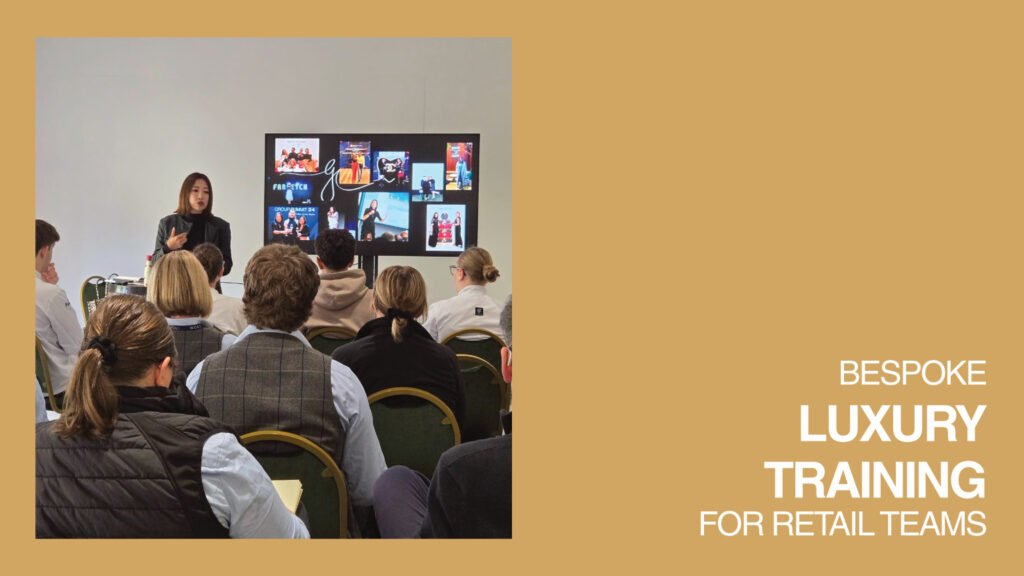
Bespoke luxury training is a capability programme built around one brand’s people, clients, culture and commercial priorities. It is commissioned when standard retail content has stopped producing change on the floor. The design starts from a diagnostic of current capability, and that diagnostic is what earns the word bespoke.
What is bespoke luxury training?
It is a customised development programme covering the behaviours a specific brand needs, which may include clienteling workshops, leadership coaching, store management capability, client development strategy or cross-market behavioural alignment. Content, sequence and depth follow the organisation’s starting point. The distinguishing feature is that the brand does not adapt itself to the training model.
Why does generic retail training underperform in luxury?
Because luxury clients are buying trust and identity, and the behaviours that build those cannot be reached through standard sales technique. A generic programme optimises the transaction, which is exactly the pressure a luxury team is already under.
The capabilities that matter are harder to teach and harder to observe. Reading a subtle client signal, developing a high-value client over years, or holding a commercial objective without letting it show all require rehearsal and feedback rather than one-off classroom instruction. A classroom can introduce them in a morning and change none of them.
What actually changes in a bespoke design?
Four variables should visibly alter the design. If a provider cannot show how each one changed the content, the programme is standard material with a different cover.
Brand positioning
A brand’s voice, heritage and client promise should be audible in the scripts, scenarios and language used during the session. Introducing a generic selling model on top of a distinctive brand voice reliably weakens both.
Team maturity
Some teams need foundational clienteling behaviours, others need advanced work in strategic client development or boutique culture. Delivering the foundation to an experienced team loses the room almost immediately, and it rarely comes back.
Market difference
Client expectations vary between regions in pace, formality and the acceptable degree of familiarity. A bespoke design permits local nuance inside a common standard, so one market’s habits are never exported to another.
Commercial priority
Appointment conversion, repeat purchase, high-value client development and boutique leadership are different problems with different content. Naming the priority before design is what allows the programme to be evaluated afterwards.
How is a bespoke programme designed?
In five stages, each producing something the client can inspect before the next begins.
• Discovery: leadership interviews, capability diagnostics through the Clienteling Excellence Diagnostic Suite, and agreement on the business objective the programme serves.
• Design: learning objectives written against brand positioning, client profile and the named commercial priority, with the behaviours to be changed stated explicitly.
• Delivery: interactive sessions combining clienteling practice, communication work, storytelling and applied coaching, using the brand’s own client scenarios, with the Clienteling Wardrobe™ used to calibrate how each participant adapts.
• Reinforcement: Learning Labs and Clienteling Embodiment Programmes, with manager coaching in the weeks that follow, which is where most of the return is won or lost.
• Evaluation: repeat diagnostics, behavioural observation and leadership feedback, read against the objective set at discovery.
Telling behaviour change from knowledge transfer
Behaviour change shows in what advisors do once the programme has receded, in appointments nobody flagged as a test. Satisfaction ratings collected on the day measure the quality of a room, and they correlate poorly with anything that happens afterwards.
Practical evidence includes observed appointments scored against the same rubric before and after, CRM records that carry usable client detail instead of a note that the client was pleasant, and follow-up completed inside the brand’s own window. The Clienteling Excellence Certification Ladder is used to make progression visible over a longer horizon than a single programme.
How does the training read the person as well as the client?
Through an instrument that works on both sides of the interaction, because an advisor who cannot see their own default will keep applying it to clients it does not suit. This matters most in mixed international teams, where a style that reads as attentive in one market reads as intrusive in another.
The Academy calls this the Clienteling Wardrobe™. It reads the client and the advisor with the same instrument, which is what makes it coachable: a manager can name the register an advisor defaults to and the one they avoid. Some are instinctive, others are learned the way a new style is learned in an unfamiliar market.
The underlying idea comes from transactional analysis (Berne, 1964). It sits inside The Art & Science of Clienteling™ alongside the SPCV model, which sharpens what an advisor notices during an appointment, and both are rehearsed in the room.
When should a brand commission bespoke work?
When a specific business change is underway and existing training is not carrying it. Vague dissatisfaction with team performance is not a brief, and it produces a programme nobody can evaluate.
• Client experience is inconsistent between boutiques serving comparable clients.
• The brand is entering new markets or absorbing a leadership transition.
• A new clienteling strategy has been announced and adoption has stalled.
• CRM or client development tools are in place and largely unused.
Programmes are designed for luxury fashion, jewellery, watches, hospitality, wine and spirits and premium lifestyle retail, drawing on our founder’s two decades of client development across Louis Vuitton, Burberry, Farfetch and DFS. Graduates can continue through the Clienteling Excellence Ambassador community, which keeps the behaviours in circulation after the formal programme closes. Outcomes vary by organisation, market and implementation quality, and nothing here should be read as a guarantee of commercial return.
Book a Discovery Call or Request a Capability Assessment
Key takeaways
• A programme is only bespoke if the diagnostic changed what was delivered, otherwise it is a standard course with the client logo on the cover.
• Attendance and satisfaction ratings tell you a room was full and warm, and nothing about whether an appointment now runs differently.
• A heritage watch maison and a premium hospitality group need genuinely different behaviour, even where their service standards read alike.
• The weeks after delivery decide the return, and that period belongs to the client’s own managers.
• A provider who cannot name the behaviours that will look different afterwards is selling content.
Frequently asked questions
Does this work for a network of one or two boutiques?
Yes, and the diagnostic stage is usually shorter because there is less variation to map. The real constraint is management time rather than team size, since one manager carries the reinforcement alone.
How does it differ from standard retail training?
Standard training transfers knowledge, bespoke work targets named behaviours and reinforces them through coaching and applied practice. The difference shows up later, in appointments rather than in the room.
How long does a bespoke programme take?
Duration follows the objective. Most organisations combine diagnostics, sessions, coaching and Embodiment Programmes across several months, because behaviour rehearsed once does not survive a trading peak.
Which sectors does this suit?
Luxury fashion, jewellery, watches, hospitality, premium automotive, wine and spirits and other premium client-facing organisations. The common requirement is high-value relationships held by named individuals.
Can programmes run across multiple markets?
Yes. A shared behavioural standard is set centrally and delivery is adapted to local expectations, with diagnostics run per market so that regional differences become visible.