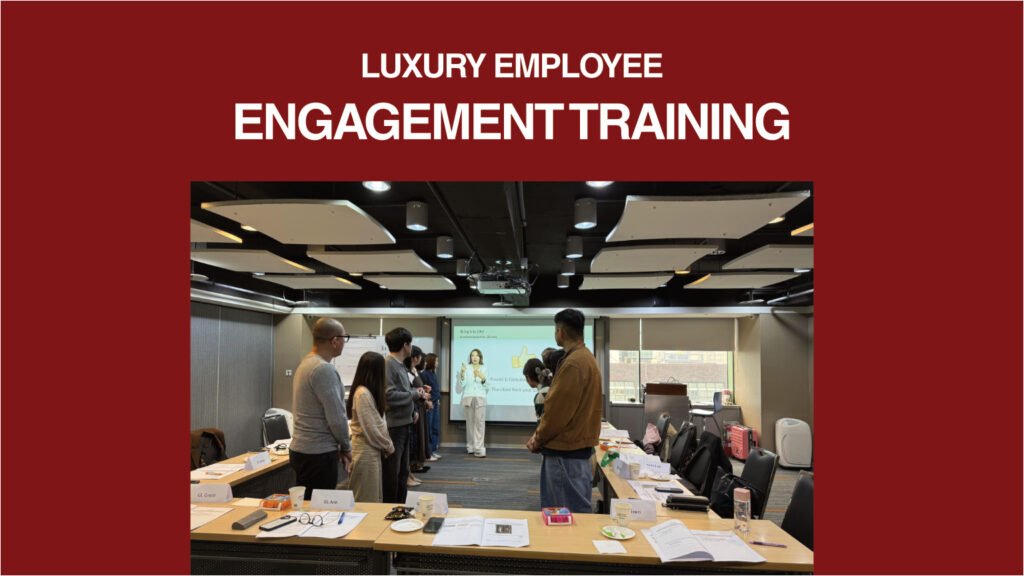
Luxury employee engagement training develops the behaviours, communication skills and leadership habits that make client loyalty possible. It starts from a commercial fact: a luxury client relationship is only as durable as the person holding it. That places engagement on the same agenda as client retention, some distance outside the HR calendar.
What is luxury employee engagement training?
It is capability building aimed at the behaviours that create both the employee and the client experience, with satisfaction scores treated as a symptom. Conventional engagement work concentrates on incentives, recognition schemes and annual surveys, all of which measure sentiment without altering what happens on the floor the following Monday. Engagement training instead gives people a clear line of sight between what they do in an appointment and whether the client comes back.
Why does employee engagement decide client loyalty in luxury?
Because luxury loyalty is held by individuals, and individuals behave differently depending on whether they feel capable and supported. Discounts and points cannot substitute for an advisor who remembers a client’s daughter’s wedding date and the reason they returned a piece last year.
Relationships sit with people
An engaged advisor adapts to the person in front of them and stops sounding rehearsed, which is what makes an appointment feel effortless. A disengaged advisor delivers the service steps correctly and leaves nothing behind, and no amount of brand prestige compensates for that.
Turnover removes client history
Clients build trust with named advisors over years, and when that advisor leaves, the informal knowledge that made the relationship work usually leaves with them. The CRM record captures a fraction of it. Retention of experienced people is therefore a direct protection of client value.
Culture is visible from the shop floor
Clients notice when a team covers for each other, shares client insight and hands over well. They also notice the opposite, particularly during a busy trading period when the seams show. Consistency of experience across advisors is a cultural output before it is a training output.
Where traditional engagement programmes stall
Most engagement programmes measure without developing. A survey identifies that follow-up is inconsistent, and a recognition scheme rewards the advisors who already do it well, while nobody teaches the rest how. Behaviour changes through rehearsal, observation and feedback in realistic client situations, which is slower and considerably less comfortable than a workshop.
Luxury raises the difficulty further, because the differences that matter are subtle. The distance between an interaction that feels transactional and one a client remembers is often a single question asked at the right moment. That is coachable, but only by someone who was watching.
How does an advisor learn to read a client and themselves?
By developing a repeatable way of noticing how a client wants to be treated, and an honest view of their own default under pressure. Most advisors have one style they reach for when a day is difficult, and it serves part of their clientele well and the rest poorly.
This is what the Clienteling Wardrobe™ is for. It gives an advisor a way to read what a client wants from an interaction, and a way to see their own habits clearly enough to change them. Some registers come naturally, others have to be learned, in the way a person grows into a piece of clothing they were unsure of at first.
The approach draws on transactional analysis (Berne, 1964), applied to the boutique floor. Its effect on engagement is indirect but reliable: advisors who can name what is happening in a difficult interaction stop taking it personally, and confidence tends to follow. The SPCV model is used alongside it to sharpen what an advisor actually observes during an appointment.
The Academy’s engagement work in three parts
The work has three connected components, on the basis that behaviour embedded once and never revisited does not survive a trading peak.
Clienteling Excellence Certification Ladder
A progressive pathway that builds capability over time for advisors, senior advisors and boutique leaders. Because progression is visible, it also functions as a retention instrument for people who would otherwise see no route forward.
Clienteling Excellence Diagnostic Suite
Individual assessments, behavioural audits and organisational reviews that establish where capability actually sits before any programme is designed. This is what prevents a generic solution being applied to a specific problem.
Clienteling Embodiment Programmes
Learning Labs and applied practice in which storytelling, influence, client development and leadership behaviour are rehearsed until they become ordinary. Managers take part in the room, because they decide which behaviours survive the week after the programme ends.
How should a luxury organisation choose an engagement partner?
On the evidence of behavioural change months after delivery. Attendance figures and end-of-day satisfaction ratings answer a different question. A short set of questions separates most providers quickly.
• Does the programme connect employee engagement to a named client outcome, or does it stop at how people feel?
• Are managers developed alongside frontline teams, or sent the slides afterwards?
• Is there a capability diagnostic before design, and a repeat measure afterwards?
• What happens in the months after delivery, when the initial energy has gone?
• Does the content reflect high-value client relationships, or has a mainstream retail programme been relabelled?
The Academy designs bespoke programmes for luxury retail, hospitality and premium brands, drawing on our founder’s two decades of client development across Louis Vuitton, Burberry, Farfetch and DFS. Participants leave with sharper client perception through the SPCV model, more adaptive communication through the Clienteling Wardrobe™ and practical leadership habits their managers reinforce. Outcomes vary by organisation, market and quality of implementation.
Book a Discovery Call or Request a Capability Assessment
Key takeaways
• A luxury client relationship is only as durable as the advisor holding it, which makes retention of people a client retention issue.
• Engagement surveys measure how a team feels without changing what happens on the floor the following Monday.
• When an experienced advisor leaves, the client history that made their appointments feel effortless usually leaves with them.
• Teams disengage fastest where standards are high and the support to meet them is thin.
• Development that never reaches the manager fades, because the manager decides which behaviours survive a busy week.
Frequently asked questions
How do we know the work has changed anything?
Repeat the capability diagnostic once enough time has passed for the initial energy to fade, and read it next to advisor retention and repeat appointment rates. Sentiment scores collected the week after a workshop tell you very little.
How does employee engagement affect customer loyalty?
Engaged advisors build stronger relationships, follow up more consistently and stay longer, which protects the client history that makes a relationship valuable. Loyalty in luxury is held by named individuals, so engagement and retention move together.
Why is a survey not enough?
A survey identifies a gap without closing it. Behaviour changes through rehearsal, observation and feedback in realistic client situations, which a questionnaire cannot provide.
Who should take part?
Client advisors, boutique managers, regional leaders and the learning and development teams who support them. Including managers matters most, because they determine which behaviours survive after the programme.
How is this different from a standard engagement provider?
The content is built for high-value client relationships and is delivered through a diagnostic, a progressive certification pathway and applied practice spread across months. Managers are developed alongside their teams.