
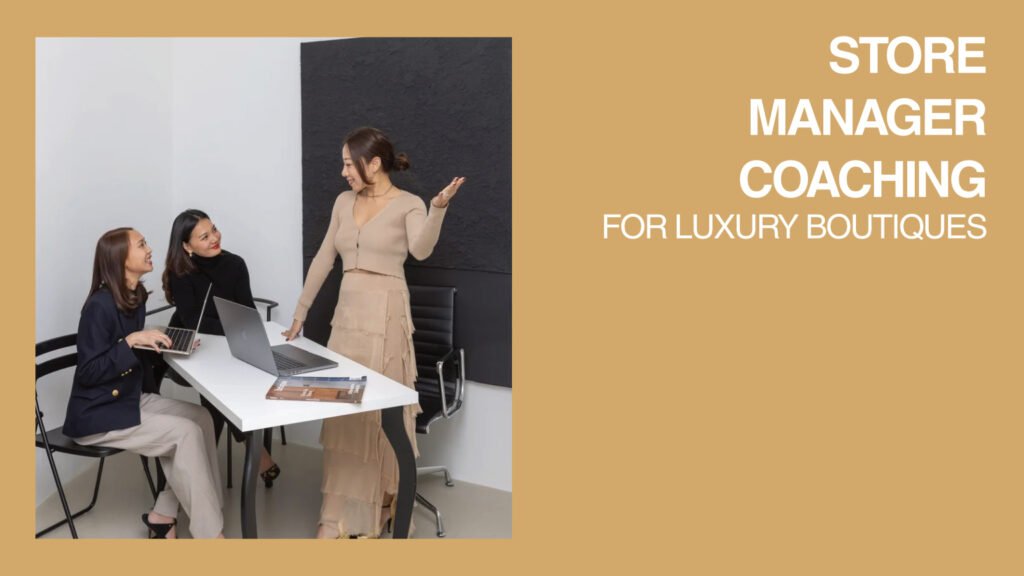
A luxury store manager coaching programme develops boutique leaders to build client advisors through observation and feedback on the floor. It treats coaching as a leadership discipline with its own techniques and cadence. The premise is that advisors grow through what a manager notices and says, far more than through what a dashboard records.
What is a luxury store manager coaching programme?
It equips boutique leaders with the frameworks and coaching techniques to develop advisors into confident relationship builders. Conventional retail coaching is corrective and arrives after results have already dropped, whereas luxury coaching works on behaviour while it is still forming. The objective is an advisor who thinks independently under pressure and stops checking with the manager before every judgement call.
Why does coaching matter more than performance management?
Because clients return for individuals, and individuals develop through feedback more than through targets. A store manager influences how an advisor prepares, what they notice during an appointment and whether they follow up, and none of those are visible in a conversion rate.
Most luxury store managers were promoted because they were exceptional advisors. That is a different skill from developing one, and very few organisations close the gap deliberately. Left alone, a strong former advisor tends to take over the difficult appointment instead of coaching someone through it, which protects this month and costs next year.
The questions behavioural coaching asks
It asks what happened during the client journey. The shift is from outcome questions, which invite defensiveness, to process questions, which invite reflection.
Before the appointment
The manager and advisor agree what is already known about the client and what a good outcome would be beyond a sale. Useful prompts include what the client bought last time and why, what the advisor intends to ask early, and what would make the visit worth repeating.
During the appointment
The manager observes without intervening, and takes note of specific moments, including the phrases used and the point at which the conversation turned. An observed appointment, logged with a date and discussed afterwards, produces more development than a review of the numbers.
After the appointment
Reflection comes before assessment. Asking what surprised the advisor, when the client seemed most engaged and what they would do differently tomorrow builds self-awareness, and self-awareness is what keeps improving once the manager is elsewhere.
Why do advisors respond differently to the same coaching?
Because people take in feedback in different ways, and a manager with one style will reliably reach part of a team while irritating the rest. Some advisors want the detail first, some want the relationship acknowledged first, and some need to be asked a question before they will accept an instruction.
The Academy teaches this as the Clienteling Wardrobe™, its instrument for reading how a client wants to be recognised and how an advisor naturally shows up. It reads in both directions, so an advisor learns their own default as well as the client’s. Much like a wardrobe, some pieces are instinctive and others take practice to wear comfortably.
The approach draws on transactional analysis (Berne, 1964), applied to the boutique floor rather than the consulting room. For a manager it does two jobs at once, sharpening how they coach an individual advisor and giving that advisor the same instrument to use with clients. The SPCV model sits alongside it to structure what a manager looks for during an observed interaction.
Coaching inside a normal trading day
It replaces parts of the day that already exist. The morning briefing becomes a conversation about one behavioural priority instead of a recital of yesterday’s figures, and appointment preparation shifts from logistics to the client.
Coaching that only appears in a quarterly review is not coaching. Short, frequent and specific beats long, rare and general, and it compounds across a team in a way a single annual workshop cannot.
What does the Academy’s coaching ecosystem include?
Three connected elements, on the basis that a standalone coaching workshop leaves managers motivated and unequipped.
Clienteling Excellence Certification Ladder
A structured pathway for advisors, senior advisors and boutique leaders that defines what excellent clienteling looks like at each level. For a manager it supplies a common coaching language, so feedback stops depending on personal preference.
Clienteling Excellence Diagnostic Suite
Assessment of individual capability, team strengths and the wider clienteling ecosystem before any development plan is written. Coaching aimed at the wrong gap is expensive and quietly demoralising.
Clienteling Embodiment Programmes
Learning Labs and applied practice where managers rehearse coaching conversations and receive feedback on them. Managers are treated as the multipliers of capability, since they determine whether anything learned in a classroom survives contact with a trading floor.
When is a coaching programme the right investment?
When the organisation is already spending on training and seeing the effect fade. The clearer signals are structural.
• Managers were promoted from high-performing advisor roles with little development in how to coach.
• Clienteling activity is inconsistent between boutiques serving comparable clients.
• Advisors know the product thoroughly and still struggle to build a portfolio that returns.
• Leadership wants a consistent coaching culture across several markets and has no shared vocabulary for it.
Programmes are designed around the brand, the culture and the commercial objective, and the work is grounded in our founder’s two decades of client development across Louis Vuitton, Burberry, Farfetch and DFS. The Art & Science of Clienteling™ supplies the structure, with The Clienteling Wardrobe™ used to adapt each coaching conversation to the advisor receiving it. Results depend on market conditions, leadership engagement and implementation quality.
Book a Discovery Call or Request a Capability Assessment
Key takeaways
• Coaching happens in the minutes before an appointment and the minutes after it, which is why a monthly review arrives far too late to count as coaching.
• Most luxury store managers were promoted for being excellent advisors, which is unrelated to being able to develop one.
• Training without a coaching manager gradually fades, because familiar habits are easier than new ones during a busy week.
• The most useful coaching question after an appointment asks the advisor what surprised them.
• Advisors interpret identical feedback differently, so a single coaching style will reliably work with part of a team and irritate the rest.
Frequently asked questions
What usually goes wrong when this is rolled out?
The common failure is a manager who reverts to taking over the difficult appointment as soon as the month gets tight. It is corrected by having regional leaders observe and coach each manager on the same rhythm managers are asked to use with advisors.
How is coaching different from sales training?
Training introduces new skills, coaching decides whether they are still in use once the novelty has gone. Regular observation, personalised feedback and applied practice are what convert a skill into a habit.
How often should a manager observe each advisor?
Often enough that observation is routine rather than an event: a full client interaction watched and logged, plus short preparation and reflection conversations around appointments. Frequency matters more than length.
How is coaching progress measured?
Through behavioural observation logs, capability diagnostics and progression against the Certification Ladder, read together with client development measures over a rolling period. Single-month movements are not evidence of anything.
Who should attend?
Boutique managers, assistant managers, regional managers and retail leaders responsible for capability across several stores. Programmes are strongest when a whole management layer attends together and shares one vocabulary afterwards.