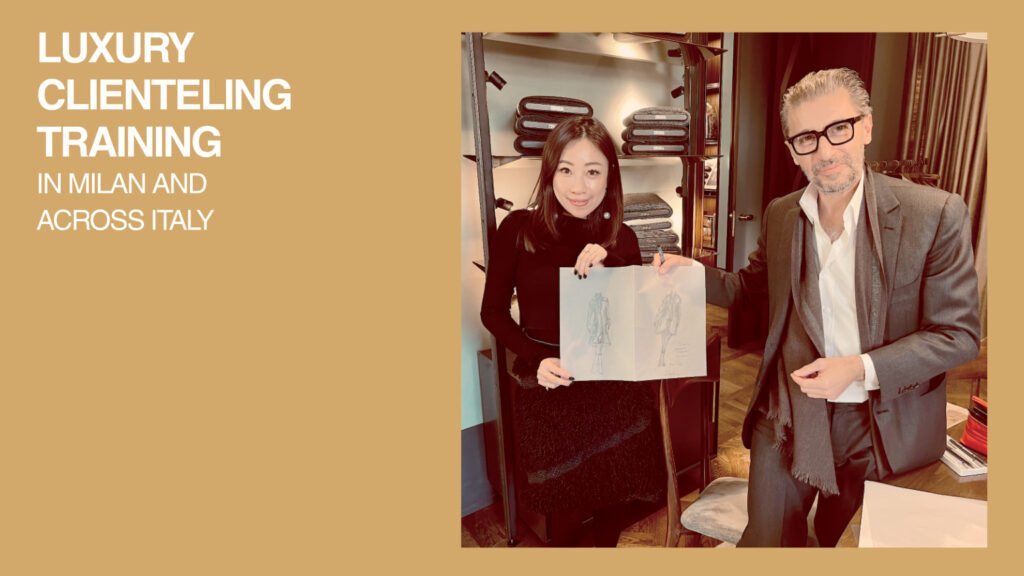
Luxury clienteling training in Milan develops what an advisor does around the sale. That means opening with a stranger, learning and recording what matters, explaining a piece well, and keeping the relationship alive once the client has flown home. Where product fluency is already strong, training adds the structured client development that makes a client book grow.
What should clienteling training in Milan cover?
Clienteling training in Milan should cover discovery, recording and follow-up: the work after the sale that product-fluent teams skip. Few advisors are taught who to contact and about what, or how to record what a client said in a form a colleague could act on. Growing a relationship across a season, instead of leaving it to whoever is on shift, is rarely taught at all.
The symptom is visible in the client book. An advisor with a strong sales month and an empty book has been selling without clienteling. A curriculum written for every market at once can miss what a flagship team already has: ease with strangers and fluency in the collection.
Product fluency is raw material, not an advantage
Proximity to the workshops gives a team something to talk about: the region, the tannery, the design intent behind a collection. The advantage is only realised when an advisor uses that material to help one particular client understand what they are paying for.
Storytelling fails in recognisable ways. Left to instinct it becomes an anecdote the advisor enjoys more than the client does. Turned into a script it becomes a recitation, and a client who has visited several houses that morning hears the difference. Knowing when to open the story and when to stop is what turns into repeat purchase, and it can be rehearsed; our page on product storytelling covers the craft.
Discovery that is never recorded is conversation
Asking a client about their travel, their collecting interest or an approaching milestone is not the difficult part. Acting on the answer is. Curiosity never written down is pleasant conversation, and the client experiences nothing from it next time.
A note a colleague could act on says what the client is considering, what was promised and what should happen next. A note that says “lovely couple, very interested” gives the next advisor nothing. Market context helps an advisor prepare, but it does not say how the person in front of them wants to be served. Discovery in Milan therefore starts where it starts everywhere: with the individual.
The client whose relationship belongs elsewhere
A Milan flagship serves the travelling client who may never return, the local regular, and the client whose purchase happens in Milan while the relationship belongs to another market. Each needs a different decision about contact, ownership and handover. Advisors seldom learn to make it, so they send the same message to all of them.
Who owns that client and what the home-market advisor is told are decisions the brand makes first. We set them out on our page on luxury clienteling in Paris and London, and they apply to a Milan flagship in full. Where systems allow, the Milan advisor’s note should reach the advisor who holds the relationship and complete the conversation. Our page on luxury tourist clienteling shows how that continuity works.
Training adds the Science to the Art
In our methodology, The Art & Science of Clienteling™, a Milan team usually arrives with much of the Art. It has ease with a stranger, fluency in the collection and the ability to tell the story of a piece. What it rarely arrives with is the Science: the commercial discipline that turns those conversations into a client book that grows.
That discipline is discovery worth recording, a note a colleague can act on, and a follow-up decided by the client’s situation rather than the rota. It is a client book the boutique manager reviews for relationships as well as sales. Training for a Milan team therefore spends less time on presence and more on what happens after the client has left. In our Learning Labs, advisors rehearse the note and the follow-up decision until both hold on a busy Saturday.
What should a brand look for in a provider?
Look for a provider that measures before it designs. A flagship in the Quadrilatero della Moda needs its own programme. It is where first-time and non-resident clients concentrate, and it is the floor head office watches most closely. What happens there sets the internal reference for what good looks like in the market. The Clienteling Excellence Diagnostic Suite is the Academy’s starting point for that measurement.
Then look at the output the provider is willing to be judged on: behaviour that can be observed on the floor and coached by the boutique manager once the provider has gone. A programme that produces enthusiasm and no change in the client book has not worked.
What this means for your team
A Milan team rarely needs to be taught how to talk to a stranger; it needs the habits that turn the conversation into a relationship. Product fluency and ease with strangers are strengths. The discipline we add sits on top of them: discovery worth recording, notes a colleague can act on, and a follow-up decision that fits the client. The luxury teams we train often find that the new habit, writing the note before the next client walks in, matters more than any new skill. This week, open the client book after a strong day and ask whether a colleague could act on what is there.
Book a Discovery Call or Request a Capability Assessment
Key takeaways
- A team close to the workshops often arrives strong on product and at ease with strangers, but thin on structured client development.
- A Milan flagship serves travelling clients, local regulars and clients whose relationship belongs to another market, and each needs a different follow-up decision.
- The test of a programme is whether the boutique manager can coach the behaviour after the provider has left.
Frequently asked questions
Can a programme cover the whole Italian network?
Yes, by diagnosing the doors first and sequencing from there, because a flagship team and a regional team rarely need the same starting point. The common language stays the same across doors, so an advisor who transfers between them does not start again.
Who should be in the room besides advisors?
Boutique managers and floor managers, without exception. They decide whether the behaviour is coached, mentioned or forgotten once the sessions end. A programme delivered to advisors alone decays at the first busy period.
How does this fit with existing product and service training?
Product training tells an advisor what the piece is. Service training gives them the sequence to follow. Neither addresses what happens between purchases.
What does the brand need to make available?
Floor time for rehearsal, access to the system the client record lives in, and managers who attend instead of nominating. Also a decision about who owns a client whose purchase happens in Milan while they live elsewhere.
How would we know it worked?
Look at the client book before revenue. Are advisors recording something a colleague could act on? Are clients contacted for reasons that are not promotional? Is a returning client met by someone who knows what was discussed last time?