
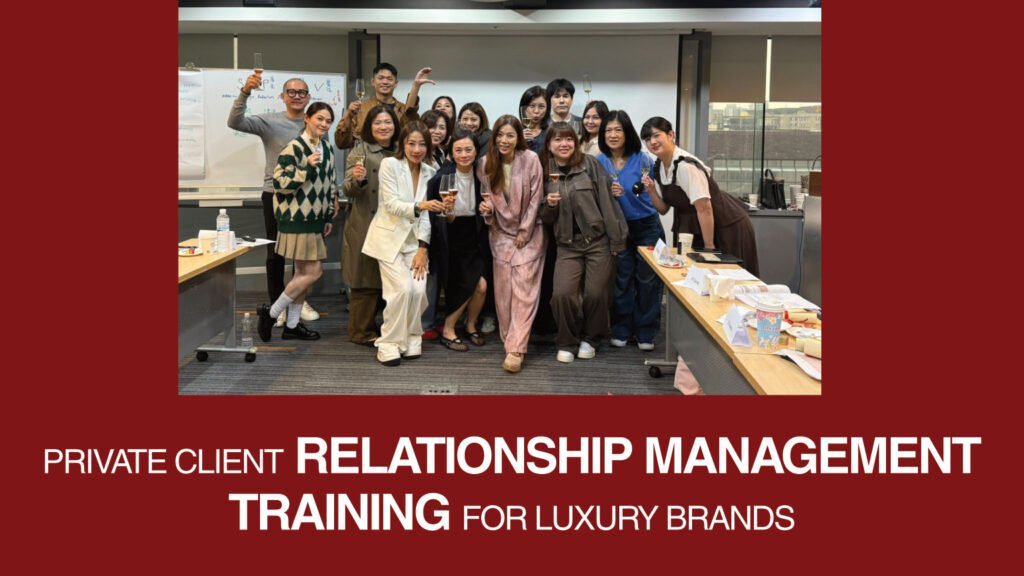
Private client relationship management training develops the capability to build and grow relationships with high net worth individuals over years rather than transactions. It combines behavioural skill with portfolio discipline, so that engagement is planned rather than triggered by whatever has just arrived in store. For luxury leaders it is a leadership programme as much as an advisor one.
What is private client relationship management training?
Private client relationship management training is a structured development programme for the people responsible for the brand’s most valuable relationships. It teaches advisors and their leaders to understand the motivation behind a purchase, to identify where a relationship can realistically grow, to personalise engagement between purchases and to build trust across boutique, showroom and digital contact.
It sits well above customer service training in scope. Service training standardises an interaction, whereas private client work asks an advisor to make judgements about where to invest limited time across a book of clients who each expect to feel like the priority.
Why does serving HNWI clients require different capability?
High net worth clients buy on trust and confidence, and both are built through behaviour that is difficult to script. A private client advisor is expected to know not only what a client purchased but why, when they are likely to engage again, how their circumstances are changing and which of their interests have nothing to do with the product. That knowledge only accumulates when someone is disciplined about gathering it.
The capability gap usually appears in three places: relationship building, portfolio strategy and consistency across a team. Each is developed differently, and conflating them is why generic programmes underdeliver.
Relationships rather than transactions
Strong advisors read emotional cues, understand lifestyle context and create experiences a client remembers months later. This is trainable through rehearsal and coaching, though it rarely improves through explanation. The Relationship Intimacy Circle gives advisors a way to assess how close a relationship actually is and what would move it a level, which turns an instinct into something a manager can discuss.
Portfolio strategy
Leading private client managers treat every book as a portfolio with a plan attached. Rather than reacting to purchases, they decide in advance which relationships receive investment this quarter and what that investment consists of. The SPCV model supports this by helping advisors evaluate a client on relationship potential rather than on recent spend, which changes who gets the phone call.
Consistency across a team
Most luxury organisations have talented individuals and inconsistent standards. Advanced training establishes shared behaviours defined precisely enough that a manager can observe them, coach them and hold people to them. Without that precision, coaching collapses into personal preference and standards drift by market.
How does an advisor learn to adapt to different clients?
By learning to recognise both what the client is asking for and what they themselves habitually offer. An advisor with a strong instinct for warmth will build rapport quickly with clients who want it and can read as imprecise to a client who wanted expertise and efficiency. The Academy teaches this as the Clienteling Wardrobe™, its instrument for reading how a client wants to be recognised and how an advisor naturally shows up. It reads in both directions, so an advisor learns their own default as well as the client’s. Much like a wardrobe, some pieces are instinctive and others take practice to wear comfortably.
The approach draws on transactional analysis (Berne, 1964), applied to the boutique floor rather than the consulting room. On the floor it is used in two directions. An advisor prepares for a private appointment by considering which register the client has responded to previously, and afterwards reviews with their manager where the conversation lost its footing. Some pieces of that wardrobe come naturally to a given advisor, others take deliberate practice, which is exactly what the Learning Labs are for, since the Clienteling Wardrobe is rehearsed there rather than explained.
Strategic private client work in practice
Consider two advisors holding equally valuable clients. The first waits for the new collection, then sends a courteous invitation that reads much like every other invitation the client received that month. The interaction is professional and entirely forgettable.
The second has mapped the client’s purchasing rhythm, family milestones, travel pattern and preferred contact style. Months before the collection arrives, they begin curating a small selection, arrange a private appointment around a date the client is already in the city, and brief a colleague in another market who will see the same client in spring. Both advisors are committed to service. Only one is managing a relationship.
How should leaders assess their current private client strategy?
Leadership teams get the most useful signal from four checks, each of which can be answered from evidence already in the business.
• Whether advisors are developing relationships or maintaining contact, which shows up in whether outreach is planned in advance.
• Whether managers coach behaviours on a set rhythm, or only when performance dips.
• Whether communication is adapted to the individual client, or applied uniformly across a book.
• Whether capability decisions rest on assessment or on assumption.
The Clienteling Excellence Diagnostic Suite answers the fourth directly, assessing individual capability, boutique performance and the wider clienteling ecosystem before any programme is designed. Starting there tends to reduce the size of the eventual investment, because it prevents brands from training everyone on everything.
How does The Clienteling Academy structure the work?
Engagements are built from three connected pillars rather than delivered as a course. The Clienteling Excellence Certification Ladder develops capability progressively across career stages, the Clienteling Excellence Diagnostic Suite establishes where an organisation actually stands, and the Clienteling Embodiment Programmes embed behaviour through Learning Labs and coaching until it holds under pressure.
Depending on need, an engagement may include The Art & Science of Clienteling™ keynote or fundamentals, Clienteling Learning Labs, behaviour excellence audits, learning ecosystem audits or a bespoke capability programme. Participants also join the Clienteling Excellence Ambassador community, which keeps standards visible between interventions. The methodology draws on our founder’s two decades of client development across Louis Vuitton, Burberry, Farfetch and DFS.
If your organisation is strengthening VIP client development or building a more consistent clienteling culture across markets, The Clienteling Academy can design a programme around your commercial objectives. Book a Discovery Call or request a Capability Assessment.
Book a Discovery Call or Request a Capability Assessment
Key takeaways
• Private client work is a portfolio discipline, and the advisor who waits for a collection launch to make contact is running a diary rather than a portfolio.
• Recent spend is the laziest proxy for client value, because it rewards the clients who were already going to buy.
• Most brands have the CRM data they need and lack the capability to turn it into a conversation worth having.
• A private client culture that rests on a handful of exceptional individuals is one resignation away from a bad year.
• Managers cannot coach what they cannot observe, which is why behavioural standards have to be written in observable terms.
Frequently asked questions
How many clients should one advisor actively develop?
There is a point beyond which an advisor can no longer prepare properly for every contact. Past it the portfolio quietly becomes a mailing list, and the top of the book receives the same attention as the middle.
Who should attend?
Brand and retail directors, boutique managers, client advisors, private client managers and VIP relationship managers who hold or oversee high value portfolios.
How is this different from customer service training?
Service training standardises interactions, while private client training teaches advisors to make judgements about where to invest time across a portfolio and how to move individual relationships forward.
What frameworks are used?
Engagements draw on The Art & Science of Clienteling™, the SPCV model, the Relationship Intimacy Circle and the Clienteling Wardrobe™, reinforced through the Certification Ladder and Embodiment Programmes.
Can programmes be tailored by sector?
Yes. Programmes are delivered across fashion, jewellery, watches, hospitality, wine and spirits and premium retail, with content shaped by a capability assessment rather than a standard curriculum.