
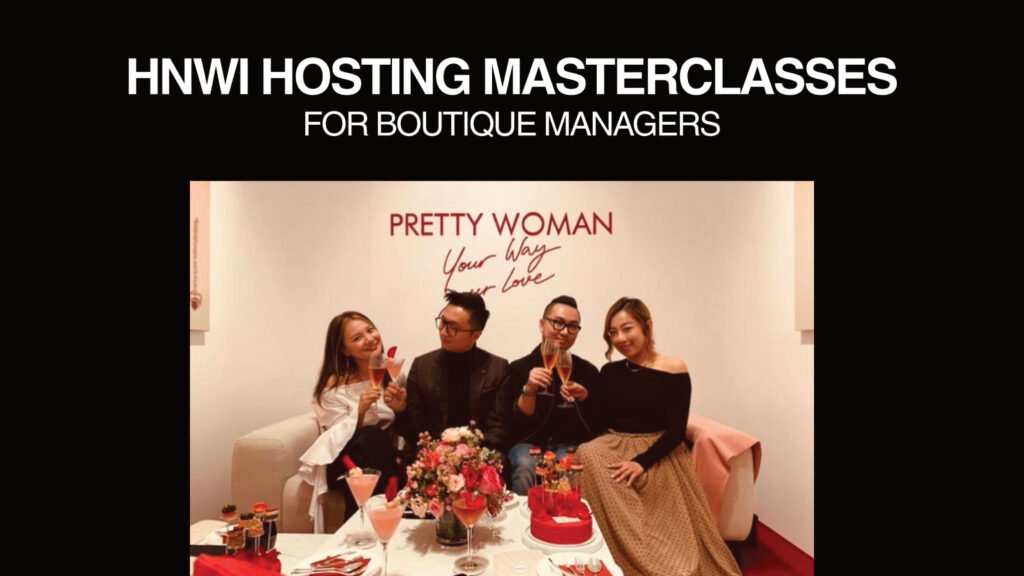
An HNWI hosting masterclass trains boutique managers to run private appointments and client events that hold up in front of people who are hosted professionally everywhere else in their lives. It treats hosting as a commercial capability rather than a service standard. The difference shows up in who comes back and who asks for a particular advisor by name.
What is an HNWI hosting masterclass?
It is a specialist programme that develops the behaviour, judgement and preparation discipline required to host high-net-worth clients through private appointments, previews and exclusive events. Conventional hospitality training standardises the welcome. Hosting at this level is built around one person, which means the manager is designing the experience rather than executing a sequence.
Coverage runs from preparation before arrival, through behaviour during the appointment and the choreography of an event, to the follow-up that decides whether any of it turned into a relationship. The last part is where most programmes stop and where most value is lost.
What makes ultra-luxury hosting different from excellent service?
Service is judged on execution. Hosting is judged on how the client felt while the execution was happening, which is a far less forgiving standard. An appointment can run perfectly to time, present the right pieces and still leave the client feeling processed.
Reading the room
Some clients want conversation and others want to be left to look. Recognising which of those it is early, and being willing to say considerably less than you prepared, is the most useful hosting skill a manager can coach. It cannot be scripted, because the signal is different every time.
Managing the invisible detail
The best hosting is largely unnoticed. Pieces are pulled before arrival, the outstanding alteration has already been chased, the colleague who knows the client’s husband has been briefed, and refreshment appears without anyone having to ask. The client remarks on none of it, which is the point.
The boutique manager’s role in hosting
The manager sets the standard the floor copies, whether or not they intend to. Advisors watch how a manager greets a difficult client, how long they stay in a conversation that is not going to convert, and how they speak about clients when those clients are not in the room. That is the real curriculum in most boutiques.
Coaching behaviour rather than compliance
The habitual coaching question after an appointment is whether the process was followed. A more useful one is how the client felt at the moment they decided to leave. The first question produces a defensive answer. The second produces information the advisor can use next time.
How should a private appointment be prepared?
Preparation should be specific enough that the advisor can be fully present in the room rather than thinking about what to fetch next. Four things are worth insisting on before every private appointment.
• Review purchase history and any outstanding alteration or repair, and resolve it before the client has to raise it.
• Select a small number of pieces with a stated reason for each, rather than a broad selection assembled to cover every possibility.
• Brief every colleague who will be visible during the visit, including who greets and who deliberately stays back.
• Agree the follow-up before the appointment begins, so that it is not improvised afterwards or quietly forgotten.
Clients rarely remember a checklist. They remember whether the conversation was interesting and whether they were treated as someone who had been expected.
Which events move relationships forward?
An event earns its cost when it moves relationships forward, not when attendance is high. Before invitations go out, a manager should be able to say who is greeting each guest, which relationships in the room are worth introducing to each other, and what the follow-up conversation will be afterwards.
Events fail quietly. The evening goes well, the feedback is warm, and then nothing happens because no one owned the follow-up. That is a planning failure rather than a hospitality one, and it is entirely preventable at the briefing stage.
The Clienteling Academy’s approach to hosting
Hosting is taught through The Art & Science of Clienteling™. The Art covers presence, storytelling, influence and the reading of what a client has not said. The Science supplies the client development structure that makes hosting accountable, including who is invited, on what basis, and what the relationship is intended to look like in future.
This is what the Clienteling Wardrobe™ is for. It gives an advisor a way to read what a client wants from an interaction, and a way to see their own habits clearly enough to change them. Some registers come naturally, others have to be learned, in the way a host grows into a room that is not yet familiar.
For a manager the practical benefit is vocabulary: a coaching conversation about why an appointment felt flat becomes specific rather than a matter of personal taste.
How does hosting capability become permanent?
Through an ecosystem rather than a single masterclass. The Academy builds hosting into three connected pillars so that the behaviour is required by the working week, not only by the classroom.
• The Clienteling Excellence Certification Ladder, which develops hosting and client development capability progressively across advisors, managers and senior leaders.
• The Clienteling Excellence Diagnostic Suite, which establishes where a boutique actually stands before any programme is designed.
• The Clienteling Embodiment Programmes, where Learning Labs and coaching turn hosting principles into instinct through repetition.
Managers who complete the pathway also join the Clienteling Excellence Ambassador community, which keeps their practice honest by exposing it to how other markets host.
Does your boutique need an HNWI hosting masterclass?
The signals usually appear well before the numbers move. Any of the following is worth taking seriously.
• Hosting standards vary noticeably between advisors on the same team.
• Private appointments end at the transaction with no agreed next contact.
• Events generate goodwill and very little measurable follow-up.
• Newly promoted managers avoid coaching conversations about behaviour.
• Advisors retreat into product knowledge whenever a client becomes uncertain.
Each of these responds better to behavioural development than to another operating procedure, largely because the procedure was rarely the thing that was missing.
Book a Discovery Call or Request a Capability Assessment
Key takeaways
• Hosting is judged on how a client felt while the execution was happening, which is why a technically flawless appointment can still leave someone feeling processed.
• The manager sets the standard the floor copies, and advisors learn most from watching how a manager handles a client who is clearly not going to buy today.
• The work that determines a private appointment happens before the client arrives, and good preparation exists to free the advisor to be present rather than resourceful.
• Events fail quietly: the evening goes well, everyone is pleased, and then nothing happens because nobody owned the follow-up.
• The Clienteling Wardrobe™ gives managers a shared vocabulary, so coaching an appointment that felt flat stops being a matter of personal taste.
Frequently asked questions
How is a masterclass delivered, and how large should the group be?
As a small cohort, because the work is rehearsal and feedback rather than presentation. Larger groups turn it into a lecture and the behaviour does not transfer.
Who should attend?
Boutique managers, private client managers, event leads and senior advisors. Managers gain the most, since they decide what the rest of the team copies.
How is hosting different from luxury customer service?
Customer service is measured on the quality of a single interaction. Hosting is measured on what the relationship looks like long after the visit.
Can the programme be adapted for different luxury sectors?
Yes. Programmes are built for fashion, jewellery, watches, hospitality, wine and spirits and lifestyle brands, using scenarios drawn from each sector’s own appointment realities.
How quickly does hosting behaviour actually change?
Change becomes visible where managers coach it as part of how they run the floor. Without that reinforcement, most teams return to previous habits quickly.