
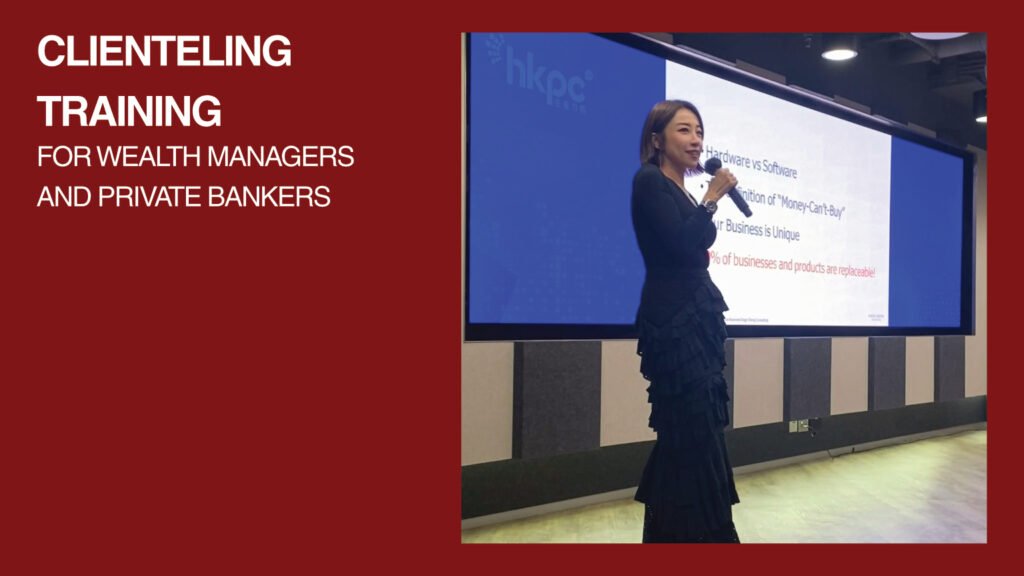
Clienteling training gives wealth managers and private bankers the relationship behaviours through which their expertise is experienced. Those behaviours are discovering what matters to the individual client, adapting how complex advice is delivered, staying curious in long relationships, and following through reliably. It sits alongside technical and regulatory training without replacing either.
What does clienteling training give wealth managers?
Clienteling training develops the human side of a role that is judged on technical competence. A relationship manager may coordinate investment specialists, lending, planning and administration for one client, and that client experiences all of it through one relationship. How well the professional listens, explains, responds and remembers is what the client actually sees.
Clienteling is the disciplined development of individual relationships through understanding, relevant communication and consistent cultivation. The training covers discovery, communication, behavioural range, preparation, continuity and follow-through. It does not cover investment advice or regulation. The purpose is not to turn a banker into a luxury advisor, but to make the advice already being given land with the person receiving it. The retail and hospitality version of these skills is on our page on HNWI relationship training.
What the relationship manager’s clients actually see
Two equally knowledgeable relationship managers can give the same client very different experiences. The difference shows in the review meeting. Is complexity explained in terms the client uses? Is uncertainty acknowledged plainly? Is the conversation built around what matters most to this client, or around the agenda easiest to present?
Clients also judge the relationship between meetings. Responsiveness, preparation and evidence that earlier conversations were remembered carry weight. So do their opposites: asking again for information already provided, an unmet commitment, or a message that ignores context. When several professionals serve one client, continuity becomes a team task. Relevant context should reach the next conversation, within the firm’s systems and permissions, so the client never has to start again.
Discovery within suitability and conduct rules
Discovery in wealth management has a formal layer and a relationship layer. The formal layer is bounded by suitability and conduct rules that define what must be established and documented. Those requirements stand. The relationship layer asks different questions: how does this client prefer to engage, what level of detail helps, and what would make this relationship work well for them?
Good discovery also knows what does not need to be known. Curiosity without a relationship purpose is experienced as intrusion. Wealth describes circumstances, not personality, so discovery starts from the individual; we set out that argument in our page on the psychology of high-net-worth buyers. The standard is useful understanding rather than maximum information.
Familiarity replaces discovery in long relationships
The longer a professional knows a client, the easier it becomes to believe the relationship is already understood. Familiarity replaces discovery, and assumptions quietly become part of the service. The professional keeps serving a version of the client that is no longer accurate.
Clients do not remain static. Circumstances, priorities and preferences move even while the relationship looks stable. Experienced professionals are efficient at recognising familiar situations, a strength that can become a habit of concluding early. Listening protects against this. It lets the professional separate what resembles a previous situation from what is distinctive about this person, and it changes the next question.
Behavioural range changes how advice is delivered
For a relationship manager as for an advisor, behavioural range starts with knowing one’s own default and the client’s preference. The Clienteling Wardrobe™ is the Academy’s own instrument for reading both. It is grounded in transactional analysis (Berne, 1964), makes no claim of validation, and widens the professional’s range without labelling the client; see The Psychology of High-Net-Worth Buyers.
In wealth management that range concerns delivery; the substance of the advice does not change with the client. How it is communicated should: the level of detail, the pace, the structure of the conversation, and how much personal warmth is welcome. The Wardrobe shows a professional their own default style, so they can recognise when it is not what the client needs and adapt without performing a different persona. That self-awareness stops personal habit from dictating every client interaction.
How is trust rebuilt after it is damaged?
Understand what happened before offering reassurance. Trust may have been affected by an unmet commitment, poor communication, an assumption that proved wrong, or something the professional has not yet recognised.
Where an error occurred, ownership matters, and the issue is addressed within the professional context before the relationship moves on. Not every damaged relationship recovers quickly. Confidence is rebuilt through subsequent behaviour: preparation, follow-through and consistency shown over time. No single conversation erases the experience. Discretion belongs here too: knowing something about a client does not mean mentioning it, and trust is often kept by what the professional leaves unsaid. The recovery principles are shared with any high-trust service; we cover them in our page on service recovery.
What this means for your team
Relationship quality in a wealth management team can be coached once it is described as behaviour. Discovery, preparation, listening, adaptation and follow-through can all be seen, practised and discussed, which moves the conversation beyond “good with clients”. The Academy’s method rehearses the moment a professional stops assuming and asks; a review meeting calls for the same discipline. The luxury teams we train often find the same thing: the habit that resists change most is concluding early with a client they have known for years. This week, before your next review, write down what you assume about the client and test each assumption in the conversation.
Book a Discovery Call or Request a Capability Assessment
Key takeaways
- Expertise is experienced through a relationship, which makes relationship behaviour a capability any professional can develop.
- Discovery in wealth management works inside suitability and conduct rules, and asks what makes the relationship work for this client.
- In long relationships, familiarity quietly replaces discovery unless the professional keeps listening.
- Trust is rebuilt through subsequent behaviour; one reassuring conversation cannot do it.
Frequently asked questions
Does clienteling training include investment advice?
No. It develops relationship capability only: discovery, communication, behavioural range, preparation, continuity and follow-through. Investment, financial, regulatory and legal training remain separate, and clienteling sits alongside them without replacing or diluting any of them.
Can experienced private bankers still change how they work with clients?
Yes. The behaviours involved are observable and practised, not innate. Experienced professionals often improve fastest because they already hold the client knowledge; what changes is how they use it, and how willing they are to keep asking questions.
Can the training be run for a single team, or must it be firm-wide?
Either. A single team is often the better start, because its manager can coach the behaviour between sessions and the change shows in that team’s review meetings first. A firm-wide rollout works once managers across the firm are ready to coach it.
How is progress measured?
Through behaviour first: quality of preparation, what was discovered in a meeting, whether communication was adapted, and whether agreed actions were completed. Managers review these alongside commercial outcomes. Retention and referral are the results those behaviours produce.