
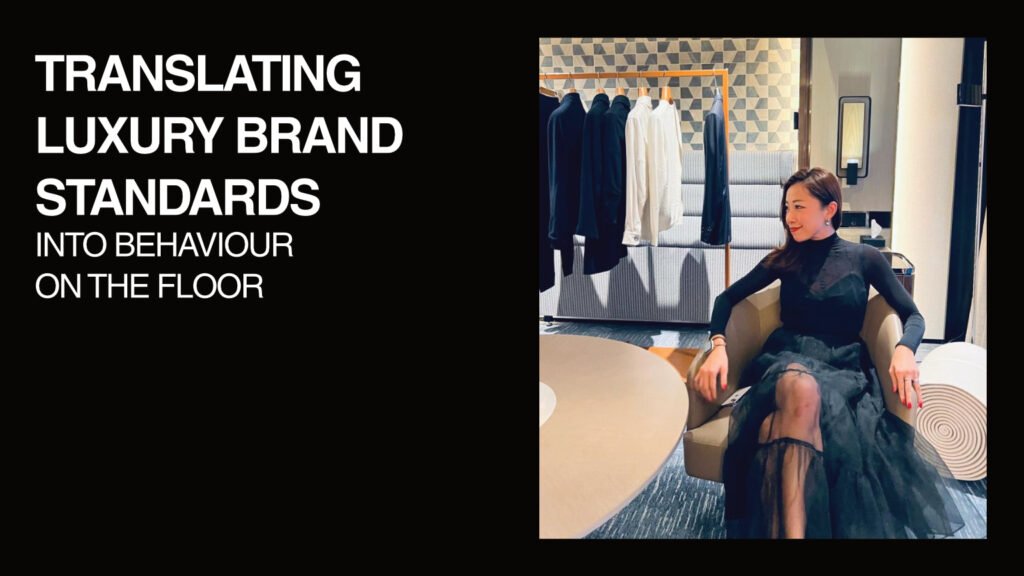
A luxury brand standard is a written statement of how a maison wants to be experienced. Translating it into behaviour is the work of converting that statement into things an advisor actually does: how a client is greeted, remembered, hosted, advised and contacted afterwards. The campaign defines the promise, the floor decides whether a client believes it, and the distance between the two sits on the brand director’s desk.
What does translating brand standards into behaviour mean?
Translating brand standards into behaviour means rewriting each standard as an action someone could observe during an appointment, then building and reinforcing that action until it holds under pressure. It goes further than product knowledge or a service script, both of which survive a single visit and then fade. The test is whether a client recognises the same maison in Paris and in Hong Kong without being served identically in both.
Why do written brand standards fail to reach the floor?
Written standards fail because they are written as adjectives, and an adjective does not tell an advisor what to do on a quiet Tuesday afternoon. Sophisticated, personal and discreet mean something different to every store manager who has to coach them, and each will coach their own reading in good faith.
• The campaign story is understood in the abstract and never rewritten into language a client would recognise.
• Boutique leaders interpret the same standard differently by market, with no forum in which the difference surfaces.
• Teams complete the service steps while missing the atmosphere the standard is asking for.
• Commercial pressure pushes behaviour back toward the transaction whenever the numbers are tight.
Clients rarely describe any of this as a brand problem. They register a boutique that felt slightly off, and the next purchase goes somewhere else. Bain and Altagamma’s Luxury Goods Worldwide Market Study has repeatedly identified in-store talent and capability as a point of differentiation when growth slows, which puts advisor behaviour on the list of brand assets rather than the list of operating costs.
Writing a standard as an action
A standard becomes usable at the moment someone can be observed keeping it or missing it. Quiet confidence becomes measured pacing, an unhurried greeting, a question asked before any product is shown and aftercare that does not push. Bold creativity becomes a clear point of view in curation and a willingness to recommend something the client did not ask for.
The drafting is best done with boutique leaders in the room rather than delivered to them as a document. A standard issued from headquarters gets interpreted on arrival; a standard written with the people who have to coach it gets used. Every value should produce a behaviour an observer could tick off during an appointment, and any value that cannot is a slogan.
Diagnosing where the standard has drifted
Behaviour drifts unevenly, and the gap is rarely where headquarters assumes it is. The Clienteling Excellence Diagnostic Suite maps current capability from individual assessment through to an ecosystem audit, which tells a brand director whether the problem sits in product storytelling, in leadership role modelling, in hosting rituals or in client development habits.
A programme designed before that evidence exists tends to address the wrong gap at considerable expense, and its results cannot be attributed to anything afterwards. Diagnosis also settles the recurring argument about whether a market is underperforming or simply expressing the standard in its own register.
How can an advisor adapt to a client without breaking the standard?
Adaptation stays inside the standard when the delivery varies and the behavioural boundaries do not. This is the working principle behind The Art & Science of Clienteling™: the emotional quality of the encounter is adapted to the person in front of you, while the structure holding it stays fixed. A client who wants precise technical detail and a client who wants warmth and unhurried conversation should leave with the same impression of the maison, arrived at by different routes.
The Academy teaches this as the Clienteling Wardrobe™, an instrument for reading how a client wants to be recognised and how an advisor naturally shows up. It works in both directions, so an advisor learns their own default before trying to read anyone else’s. Like a wardrobe, some pieces are instinctive and others take practice to wear well in front of a demanding client.
The approach draws on transactional analysis (Berne, 1964), applied to the boutique floor. For a brand director the practical value is that adaptation becomes teachable, so consistency stops depending on which advisor happens to be on the floor when a client walks in.
The same standard in different brand contexts
Heritage maison
Storytelling in a heritage house has to connect archive, material and the client’s own life, because a founding date on its own does no work in an appointment. A strong execution sounds like a recommendation: noting that a piece carries the maison’s restraint and suits a client who prefers distinction without announcement.
Contemporary brand
A contemporary brand needs cultural fluency and a confident styling point of view from its advisors, with enough refinement that informality does not tip into familiarity. The behaviour worth coaching hardest here is the follow-up, which has to be specific, prompt and visibly untemplated.
Multi-market network
One market over-indexes on warmth, another on efficiency, another on product detail, and each believes it is delivering the brand correctly. The standard stays constant while local expression is permitted inside it, and a shared behavioural vocabulary is what lets regional teams describe where they differ instead of settling the question by seniority.
What holds the behaviour when the numbers are tight?
Behaviour holds when a line manager keeps reinforcing it, in briefings and in observed appointments, and when the brand stops rewarding the opposite. Commercial pressure pushes teams toward the transaction, and no amount of restating the values will outrank an incentive that says otherwise. The Clienteling Excellence Certification Ladder gives that reinforcement a shared vocabulary across markets, so a director at headquarters and a manager in Dubai describe the same standard in the same words.
Practice is the other half of it. Clienteling Embodiment Programmes and Learning Labs place advisors in rehearsed client situations with feedback given in the room, because an inspiring workshop does not change how someone greets a client on a difficult afternoon. Repetition under observation does.
When should a brand director start this work?
The moment to start is when campaigns are performing and in-store execution is uneven, which usually shows up in reporting before anyone can name the cause. The clearer triggers appear during store visits and in client feedback broken down by location.
• Client experience results vary widely between boutiques serving comparable clients.
• New collections reach the floor as stock, with no story a client could repeat afterwards.
• Boutique leaders describe the same standard in incompatible terms.
• A regional team has been asked to lift relationship-led growth without a common behavioural language.
The Academy supports this through training where the required shift is already clear, through audit and evaluation where it is not, and through masterclasses for senior and regional leaders. A capability assessment is usually the cheapest way to establish which of those is needed, and the work is grounded in our founder’s two decades of client development across Louis Vuitton, Burberry, Farfetch and DFS. Results depend on market, leadership commitment and implementation, and nothing here should be read as a guarantee of commercial return.
Book a Discovery Call or Request a Capability Assessment
Key takeaways
• A brand standard written as an adjective cannot be coached, because sophisticated and personal mean something different to every store manager who has to teach them.
• A standard becomes usable at the moment someone can be observed keeping it or missing it during an appointment.
• Clients rarely name a brand standards problem; they register a boutique that felt slightly off and take the next purchase elsewhere.
• Standards written at headquarters get interpreted, while standards written with the leaders who have to coach them get used.
• No amount of restating the values will outrank an incentive that quietly rewards the opposite behaviour.
Frequently asked questions
Is this the brand team’s responsibility or the retail team’s?
It belongs to both, and it stalls whenever one of them owns it alone. Brand defines what the standard means, retail decides what it looks like in an appointment, and the drafting has to happen in the same room.
How long before the change is visible in stores?
Individual boutiques show a shift in observed behaviour first, while a standard that holds right across a network takes considerably longer. Anything that looks faster than that is usually enthusiasm rather than habit.
What if a market insists its clients expect something different?
Test the claim against the diagnostic before conceding or overruling it. Genuine local expectation shows up consistently across boutiques in that market, while a preference held by one leadership team does not.
Do the same standards apply in outlet and travel retail environments?
The standard applies, the expression changes. Pace, dwell time and client intent are different in an airport from a flagship, so the behaviour has to be rewritten for that setting rather than waived for it.
Does this apply outside fashion?
Yes. Jewellery, watches, hospitality, wine and spirits and premium lifestyle retail all depend on human behaviour to make a brand promise credible, and the method for translating a standard into behaviour is the same.